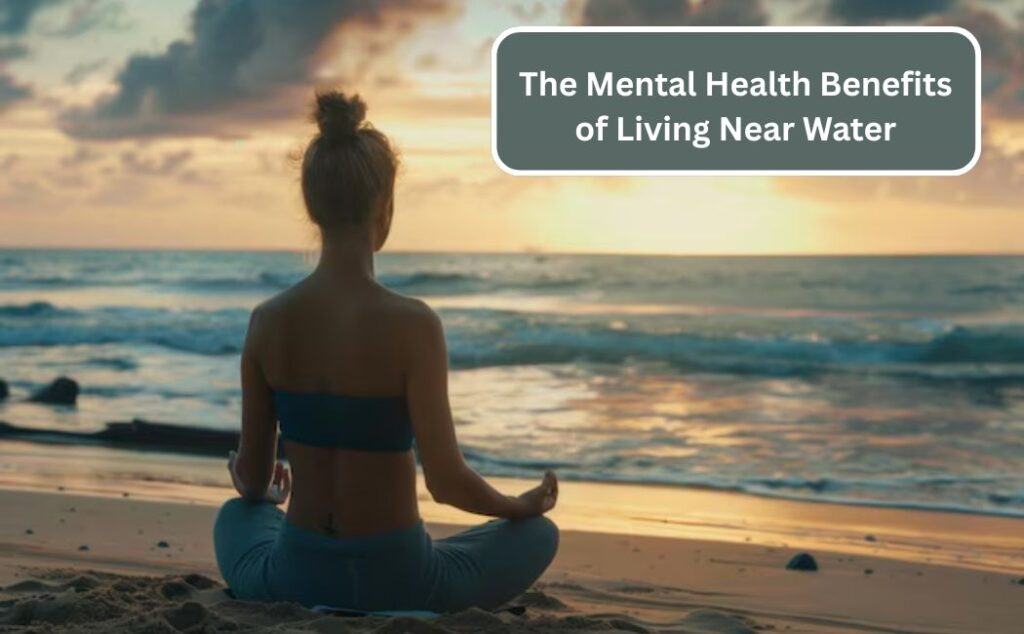
There’s a moment that happens to almost everyone who stands at the edge of the ocean for the first time in a while. Your shoulders drop. Your jaw unclenches. Something in your chest loosens — something you’d stopped noticing was tight. You exhale differently. In that single moment, you feel something shift, though you’d probably struggle to put words to exactly what.
I used to dismiss that feeling as nostalgia, or as the simple pleasure of being on vacation. But ever since I moved to the Gulf Coast and started living within walking distance of the water every single day, I’ve had to ask a different kind of question. Is this just happiness? Or is something more specific happening — something that science might actually be able to explain?
Turns out: it’s both. And the science is a lot more compelling than I expected.
What Researchers Mean When They Say “Blue Space”
Before we get into the research, it helps to understand the term that scientists use when they’re studying this. “Blue space” — distinct from the more well-known “green space” (parks, forests, gardens) — refers to any environment where water is the central feature. That includes the obvious: oceans, beaches, bays, rivers, and lakes. But it also includes canals, urban water features, ponds, and even well-designed fountains in city squares.
The field of blue space research is relatively young compared to green space research, but it’s been growing rapidly over the past decade, fueled in large part by the European Union’s BlueHealth research program, which ran across multiple countries and generated some of the most comprehensive data we have on how proximity to water affects human wellbeing.
The short answer to the question in this article’s title? Yes. Living near water is genuinely good for your mental health. But as with most things in science, the full picture is richer, more nuanced, and more interesting than a simple yes or no.
The Science: What the Research Actually Shows
Large-Scale Population Studies
Let’s start with the numbers, because they’re genuinely striking.
A landmark study published in Scientific Reports surveyed people across 18 different countries — more than 16,000 respondents total — and found that people who lived in coastal or greener neighbourhoods reported higher positive wellbeing. Those who visited blue spaces more frequently showed significantly lower levels of mental distress and better overall well-being, independent of other lifestyle factors. This wasn’t a small or localized study. It was one of the most geographically diverse explorations of blue space and mental health ever conducted.
A University of Exeter study, one of the most detailed investigations into coastal wellbeing ever undertaken, analyzed survey data from nearly 26,000 respondents in England. It found that living near the coast was linked to better mental health — particularly for people in lower-income households. This finding matters because it suggests blue space isn’t just a luxury for the wealthy; it’s a mental health resource with real potential to reduce health inequalities for people who have fewer other buffers against stress.
One of the largest studies of all tracked over 2.8 million adults in Wales for a full decade, linking their health records to data on proximity to green and blue spaces. People living in greener and bluer areas were measurably less likely to seek help for anxiety or depression. The benefit was strongest for those in the most economically deprived areas, which is a meaningful finding, because it suggests that protecting public access to water isn’t just about aesthetics. It’s a public health issue
A 2024 study published in BMC Medicine used data from the UK Biobank — one of the largest biomedical databases in the world, following 363,000 adults over more than a decade — and found that exposure to green and blue space was associated with a lower incidence of psychiatric disorders overall.
The Irish and Scottish Evidence
Research from Ireland found that older adults who had better views of the sea and experienced more frequent coastal exposure reported lower depression scores compared to those living further inland. A separate study of Scottish adults found that those with better access to freshwater spaces showed lower rates of antidepressant use — a particularly striking proxy for mental health, because antidepressant prescriptions are one of the hardest clinical outcomes to influence through environmental factors alone.
Why Water? The Neuroscience Behind the Feeling
The research shows the correlation clearly. But the more fascinating question is: why? What is actually happening in your brain and body when you’re near water?
This is where the work of marine biologist Dr. Wallace J. Nichols becomes essential. His landmark book Blue Mind, now in its 10th anniversary edition, synthesized cutting-edge neuroscience, psychology, and personal testimony to explain the mechanisms behind our connection to water. Nichols coined the term “blue mind” to describe the mildly meditative, calm, and open mental state that humans tend to enter when near, in, on, or under water. It’s not poetic — it’s physiological.
1. Your Nervous System Actually Changes
When you’re near water, your parasympathetic nervous system — the one responsible for “rest and digest” rather than “fight or flight” — becomes more active. Your heart rate slows. Your breathing deepens and steadies. Your cortisol levels, one of the primary biological markers of stress, drop measurably. Studies measuring physiological responses like breathing rate, heart rate, blood pressure, and skin temperature have all consistently shown that blue spaces calm us in ways that can be tracked in a lab.
Water also triggers a neurochemical cascade that has a powerful effect on mood. Proximity to water stimulates the release of dopamine (associated with reward, pleasure, and motivation), serotonin (the so-called happiness hormone), and oxytocin (the bonding and connection hormone), while simultaneously decreasing cortisol. The color blue alone has been associated with dopamine release. The net result is a neurochemical environment that is fundamentally incompatible with the way most modern stress feels.
2. Attention Restoration: Your Brain Gets to Rest
Modern life is defined by what psychologists call “directed attention” — the effortful, focused concentration we use to manage tasks, screens, decisions, and stimulation. This kind of attention fatigues. The feeling of brain fog at the end of a hard day, the inability to concentrate after hours of Zoom calls, the emotional flatness that comes from too much stimulation — these are all symptoms of directed attention fatigue.
Water is one of the most effective natural remedies for this. Watching waves or rippling water engages what researchers call “soft fascination” — a gentle, effortless form of attention that allows the brain’s executive function to rest and recover without requiring you to do anything. You’re not bored. You’re gently absorbed. And in that absorption, something resets.
This is why people who live near water so often describe their beach or riverside walks as “restorative” rather than just pleasant. It’s not metaphor. It’s attention restoration theory in action.
3. The Sound of Water Changes Your Brain State
The auditory experience of water — the rhythmic crash of waves, the babble of a river, the gentle lap of a lake against a dock — has been shown to have a direct neurological effect. Studies have demonstrated that listening to water sounds prompts the production of neurochemicals, including dopamine and oxytocin, promoting relaxation and reducing the physiological markers of stress.
Nichols noted that the predictability of ocean sounds is part of what makes them effective. Unlike a busy street, where sounds are random, unpredictable, and demand attention, the ocean follows a rhythm. It’s the same from moment to moment, with just enough variability — a different wave height, an occasional seabird — to hold gentle interest without triggering the threat-detection systems of the brain. It’s a normalizing background. Your nervous system literally settles into it.
4. Awe: The Emotion That Changes How You See Yourself
Water — particularly large bodies of water like the ocean or a wide lake — is one of the most reliable triggers of awe in human experience. And awe, as psychologists have come to understand it over the past two decades, is not a trivial emotional luxury. It’s a functional state with significant cognitive and emotional effects.
Research shows that awe restructures cognitive frameworks. It produces a feeling of smallness — not existential dread, but a healthy sense of being part of something larger than your immediate concerns. This psychological distance from one’s own worries and anxieties is measurably associated with reduced rumination, better emotional regulation, and increased empathy. Nichols called the ocean “an empathy factory” — and it turns out that’s almost literally true.
What Happens When You Actually Get In the Water
Living near water gives you proximity and the passive benefits that come with it. But getting in the water — swimming, paddling, surfing, diving — adds another dimension entirely.
Open Water Swimming: One of the Most Interesting Bodies of Evidence
A 2023 scoping review of 14 studies on open water swimming found consistent evidence of improvements in mood, reductions in anxiety and depression symptoms, and what researchers described as “embodied mindfulness” — a deep, full-body present-tense awareness that the cold water and physical effort demand. Participants described reductions in tension, anger, fatigue, and depressive symptoms.
One remarkable case study, published in the BMJ Case Reports, documented a 24-year-old woman with treatment-resistant major depressive disorder — unresponsive to multiple antidepressants and cognitive behavioral therapy — who was introduced to a weekly program of open cold-water swimming. After the first swim, she reported an immediate improvement in mood. Over weeks, her symptoms decreased steadily. After continuing the practice, she was able to come off her medication entirely. At one-year follow-up, she remained symptom-free.
That is a single case report, not a clinical trial, and should be understood as such. But it points toward a mechanism — potentially the cold shock response stimulating norepinephrine release, or the combination of physical effort, natural environment, and community — that researchers are now taking seriously.
A 2025 study across 19 countries compared open-water (wild) swimming to swimming in open-air pools and found that wild swimming was associated with significantly higher positive wellbeing, suggesting it isn’t just the exercise, and it isn’t just being outdoors. There’s something specific about swimming in natural water.
Surf Therapy: PTSD, Youth, and Veterans
Surf therapy has been quietly building an evidence base for over a decade, and the results are striking. A systematic review published in 2024 found consistent evidence across multiple controlled studies that surf therapy was associated with significantly lower PTSD and depressive symptoms, increases in positive affect, and decreases in anxiety and depression — both at the conclusion of the therapy and at 30-day follow-ups.
For combat veterans, surf therapy has been explored as a way to address PTSD that is notoriously resistant to conventional treatment. Multiple studies found that surfing in the ocean elevated subjective well-being through a combination of: physical flow states, a sense of respite from intrusive thoughts, increased positive emotion, and the social bond that tends to form naturally in surf communities.
For at-risk youth, Australian research on the Waves of Wellness Foundation’s 8-week surf therapy program found measurable improvements in mental health outcomes among adolescents who participated. The researchers pointed to the “unique affordances” of immersion in ocean blue space as a key factor — something the ocean environment specifically offers that a gym or a counseling room simply cannot replicate.
But Wait — Is the Science Solid?
Good question, and worth asking. Because while the evidence is genuinely compelling, there are real caveats worth understanding.
Correlation vs. causation remains a challenge. Most of the large population studies are observational. They show that people near water tend to have better mental health — but they can’t always rule out that people with better mental health choose to live near water, or that wealthier people (who have better mental health on average) are more likely to afford coastal real estate.
Access matters enormously. Researchers have found that simply living close to water doesn’t produce the same benefits as regularly visiting and engaging with it. Proximity is not enough if it isn’t paired with actual time spent at the water’s edge.
Not all water is equal. The mental health benefits of blue space appear to be closely tied to water quality and safety. Polluted, unsafe, or inaccessible water doesn’t produce the same effects. This has real policy implications for how cities maintain and protect public access to natural water.
Individual differences are real. Some people find large bodies of water anxiety-inducing rather than calming. Thalassophobia (fear of the ocean) is a real and common experience. Blue space research tends to reflect population-level averages, not universal truths.
What the research does show, consistently and across many countries and methodologies, is a meaningful association between blue space and better mental health. The biological mechanisms are increasingly well-understood. The effect appears to be real. But it isn’t magic, and it isn’t a substitute for professional mental health care.
What This Looks Like in Real Life — Living It, Not Just Studying It
I want to step away from the science for a moment, because this has been my life for the past several months, and the research has given me a language for things I was already experiencing.
There are mornings here on the Gulf Coast where I walk to the water before I’ve looked at my phone or opened my laptop, and something about the quality of the day changes. The light is different — low and warm, moving across the surface. The sound is there before anything else, that particular rhythm that doesn’t vary much but never exactly repeats. By the time I turn back toward the house, I feel like myself again in a way that didn’t feel possible at 6am. That’s soft fascination. That’s parasympathetic activation. That’s a cortisol level doing exactly what the scientists say it does near water.
But here’s what I didn’t expect: it’s cumulative. Living near water isn’t like visiting the beach on vacation, where you get a concentrated hit of wellbeing and then return to your regular life. It’s quieter and more constant than that. It’s having a low, steady hum of something that replenishes you, so that when hard weeks arrive — and they do — you’re drawing from a fuller reserve.
I don’t think I’m imagining this. The research suggests I’m not.
You Don’t Have to Live on the Coast to Get the Benefits
This is perhaps the most important practical finding from the entire body of blue space research: you don’t need ocean frontage to access these benefits. “Urban water counts,” as NBC’s medical contributor Dr. Natalie Azar has noted. Rivers, canals, ponds, fountains — any meaningful water feature in a natural or semi-natural setting appears to offer real mental health benefits, particularly when you engage with it consistently.
Even watching videos of water, or listening to ocean sounds, has shown some measurable effects in research settings — though these are less powerful than actual physical presence.
What the research suggests is not that you need to move to a coastal town (though if you’re considering it, there’s now quite a lot of evidence in favor of the idea). It’s that intentional, regular contact with water — in whatever form is available to you — is a genuinely evidence-backed addition to a mental health toolkit.
Your city’s river walk. The lake at the edge of town. A canal path. A waterfall in a botanical garden. These are not consolation prizes. They’re real blue spaces with real effects on the human brain and body.
How to Actually Use This Information
Science doesn’t tell you to move. But it does offer a few concrete, evidence-backed practices:
Spend time at the water regularly, not just occasionally. The benefits appear to compound with frequency and consistency, not intensity. A short walk along a river three times a week likely does more than one big beach vacation.
Engage rather than just pass through. Studies show that active engagement with blue spaces — swimming, walking at the edge, sitting and watching the water — produces stronger benefits than simply living near water without connecting with it.
Combine water with movement. Physical activity in or near blue spaces appears to have a synergistic effect — the mental health benefits of exercise are amplified when the exercise happens near water.
Go toward the water when you’re stressed. This sounds obvious, but most of us don’t. We reach for our phones. Research on stress recovery suggests that even a short visit to a blue space during a high-stress day can measurably lower cortisol and restore directed attention.
In winter or when the coast isn’t accessible, experiment with the sounds. Not as powerful as the real thing, but the neurochemical response to water sounds is real, and a 20-minute recording of waves is accessible to virtually anyone.
The Honest Conclusion
The mental health benefits of living near water are real, they are well-documented across substantial international research, and the biological mechanisms behind them are increasingly well understood. This is not wellness marketing. It is not beachside romanticism. It is, at this point, serious science — published in peer-reviewed journals, replicated across multiple countries, and studied with hundreds of thousands of participants.
Is water a cure for depression or anxiety? No. Is it a replacement for therapy, medication, or other evidence-based mental health treatments? Absolutely not. Should any of us feel guilty for not living near a body of water? Of course not.
But if you’ve ever stood at the edge of the ocean and felt something in you settle — if you’ve ever walked along a river and returned home feeling like more of yourself — that wasn’t nothing. That wasn’t just your imagination. That was your nervous system doing exactly what it’s apparently been doing for as long as humans have lived near water: recovering, restoring, and breathing again.
There are worse things to build a life around than that.
If you’re thinking about what it actually looks like to build a life near the water, I’ve been writing about that exact thing on this blog — from the practical realities of coastal town living to the style, wellness, and morning routines that make it work. Subscribe to the newsletter for more, or read my recent piece on Sarasota vs. St. Pete if you’re weighing your own Gulf Coast move.