I have a Saturday morning ritual that I’m deeply, unashamedly attached to.
Coffee first — always. Then the farmers’ market. There’s something about those two hours every week that resets me in a way nothing else quite does. The smell of just-cut flowers. The particular quiet of a morning before the city fully wakes up. The vendor who remembers I always buy the same sourdough and has it bagged before I even reach his table. The tiny, unhurried pleasure of picking out a bunch of sunflowers and carrying them home like I’ve got the whole morning and nowhere to be.
I’ve been going to farmers markets for years now — from Atlanta’s Ponce City Market days to the Sarasota Farmers Market on Lemon Avenue and the Sunday market over at Siesta Key Village. And over time, I’ve figured out something important about how to dress for them. It’s not as simple as “wear something cute,” and it’s not as complicated as people make it. It’s really about understanding what a farmers’ market actually asks of your body and then building a look around that reality.
Because here’s what nobody tells you until you’ve worn the wrong thing: farmers’ markets are deceptively physical. You’re walking for two hours on a mix of concrete, gravel, and occasionally damp grass. You’re reaching over tables, bending down to look at lower stalls, carrying bags that get heavier with every purchase. You’re in the sun. You’re jostling through a Saturday crowd. And you want — at minimum — to feel cute enough to actually enjoy the experience rather than spend it tugging at your clothes.
This guide is the one I wish I’d had when I first moved to Sarasota and started building my Saturday morning wardrobe from scratch. It’s organized by what actually works, with outfit ideas for every season and real talk about the things that don’t.
The Golden Rules of Farmers’ Market Dressing
Before we get into specific outfits, there are a few principles that govern every successful farmers market look. Think of these as the foundation on which everything else is built.
Comfort is not the enemy of cute. This is the most important thing I can say. The farmers market is one of the few occasions where comfortable and stylish are genuinely, completely compatible — and yet it’s also where I see the most people in completely impractical clothing standing awkwardly near a produce stand they’re afraid to bend over at. You don’t have to choose between looking good and being physically comfortable. The outfit formulas in this guide give you both.
Breathable fabric is non-negotiable. Especially in Florida, and especially from March through October when the heat arrives early and stays late. Linen, cotton gauze, washed cotton, and lightweight modal all breathe. Polyester, heavy denim, and synthetic blends do not. Your body will tell you the difference within twenty minutes outdoors, and no outfit is cute enough to justify sweating through it at a vegetable stall.
Footwear makes or breaks everything. You are going to walk — probably more than you think. Flat sandals with cushioned footbeds, leather or suede flats, espadrilles, sneakers, and Birkenstocks all work. Heels do not. Thin-soled flip-flops technically work, but will leave your feet complaining by the time you’ve made it to the flower vendors. Choose something with actual arch support and a sole thick enough to handle uneven surfaces.
You will buy more than you planned. This happens every time, to everyone. A tote bag that starts the morning looking spacious will, by 10:30 AM, contain a quart of cherry tomatoes, two bundles of herbs, a sourdough loaf, a jar of local honey, and a bouquet of zinnias you didn’t plan to buy. The bag you bring needs to be large enough to accommodate your optimism, and ideally sturdy enough not to stretch out of shape when it’s loaded.
Morning chill and afternoon warmth are real. Especially in fall, winter, and early spring, the first hour at the market is often fifteen degrees cooler than the second. A layering piece you can tie around your waist or stuff in your bag is always worth bringing.
Best Outfit Ideas for Farmers Market
These are the looks I actually reach for, and the ones I see working well week after week on the women who make the farmers market feel like a fashion moment rather than an afterthought.
1. The Linen Maxi Dress
This is the queen of farmers market outfits, and for good reason. A linen maxi dress in a warm neutral — cream, oat, warm sand, dusty terracotta, soft sage — does everything you need. It keeps you cool, it moves beautifully when you walk, it photographs well against the color of produce and flowers (seriously, this matters more than anyone admits), and it requires essentially zero styling decisions.
The secret is in the fabric. Linen wrinkles in a way that reads intentional rather than sloppy, and it actually looks better as the day wears on. By the time you’re haggling over the last bunch of ranunculus, your linen maxi has developed a relaxed rumple that’s more beautiful than when you walked out the door.
Pair it with leather flat sandals or espadrilles, a large canvas or straw tote, gold hoop earrings, and your best sunglasses. Add a thin woven belt if you want a little shape. That’s the whole outfit. It’s done in three minutes, and you’ll feel effortlessly put-together the entire morning.
What to avoid with a maxi: very thin fabrics that turn transparent in direct sunlight (hold it up to the light before leaving home), anything with a long train that’ll drag on the ground and collect mud at market edges, and all-white when handling fresh produce and samples — because you will touch something wet.
2. The White Tee + High-Waisted Jeans (or Wide-Leg Linen Trousers)
This combination is the ultimate “I look like I have my life together without actually having tried” outfit, and it works at the farmers market specifically because of its clean, unfussy energy.
A simple white or off-white tee — slightly oversized or fitted, both work — tucked partially into high-waisted jeans or wide-leg linen trousers is the casual-chic baseline that makes everything you layer over or around it look polished. Add a denim jacket or light cardigan on cooler mornings. Swap the jeans for wide-leg linen pants if the heat demands it.
The footwear options are generous here: white sneakers give it a clean, modern edge; leather sandals dress it up slightly; Birkenstocks make it feel more laid-back and granola; loafers add a little polish. Pick your energy for the morning and go.
Accessories do the heavier lifting with this outfit, since the base is so simple. Gold hoops, a dainty layered necklace, a structured straw bag or canvas tote, and sunglasses with a strong frame. Optional but wonderful: a good baseball cap or wide-brim straw hat for the sun.
The tucked-in-tee rule: tuck at least one corner into your waistband rather than letting the shirt hang fully loose. This one tiny move makes the whole silhouette look more intentional. You can untuck everything once you’re hauling a heavy tote, but that first hour of tucked-in energy photographs beautifully.
3. The Midi Floral Dress
If the linen maxi is the queen, the midi floral is her more fun, slightly flirtier sister. A floral midi dress — particularly in an A-line or wrap cut, in earthy or muted tones rather than neon-bright florals — is one of the most photographically satisfying farmers market outfits there is, because it mirrors and complements everything around it: the colors of the flowers, the textures of the produce, the particular warm quality of Saturday morning light.
Look for florals that feel collected and vintage rather than tropical-loud. Dusty rose and marigold. Sage and cream. Terracotta and ivory. Deep burgundy with small white flowers. The market setting makes busy, colorful florals feel slightly overwhelming — the earthy-toned approach photographs like you planned the whole thing.
Espadrilles or flat strappy sandals are the ideal footwear pairing. A crossbody bag keeps your hands free. A straw hat if you’re in the sun. One good pair of earrings. Nothing else is needed.
The wrap dress advantage: if you buy a wrap-style midi, you get the extra practical benefit of adjustable fit as the morning progresses and the temperature rises. Loosen the ties, open the neckline slightly — the wrap dress adapts to you.
4. Denim Overalls + A Simple Top
I have complicated feelings about overalls. They are, objectively, one of the most farmers market-coded garments in existence — almost parody-levels of appropriate for the occasion. And yet every time I see someone actually wearing them well, they look perfect. Not try-hard. Not ironic. Just right.
The key is styling them with intention rather than ironically. A simple fitted white or cream tank or tee underneath, well-fitted (not baggy) overalls in a medium or light wash, and good footwear. Sneakers — white or neutral — are the cleanest option. Birkenstocks work. Ankle boots work for fall. The overall itself does enough visual work that you need the rest of the outfit to be quiet.
Accessories should be minimal: a small crossbody bag in addition to your tote (so you have somewhere for your phone and card that isn’t buried at the bottom of a produce bag), gold hoops or studs, and sunglasses. A baseball cap or bucket hat if the sun is high.
Overalls work best for the market specifically because of the practical benefits nobody talks about: they have pockets (actual, real pockets), they’re fully machine washable without drama, and they give you complete freedom of movement. You can squat down to look at lower shelves, reach across a table, carry bags in both hands, and do all of it without once thinking about your clothes. That’s the goal.
4. The Matching Linen Set
This is the easiest outfit I own for farmers markets, full stop. A coordinating linen set — wide-leg trousers and a simple tank, or linen shorts and a relaxed button-up — looks deliberate even when assembled in ninety seconds, and linen’s particular casual elegance makes the whole look read as effortlessly put-together.
Color-wise, lean into the coastal palette: warm whites, sandy ecru, soft sage, terracotta, muted coral. These tones are universally flattering in outdoor morning light and have a natural compatibility with the visual texture of a market setting — fresh flowers, colorful produce, weathered wooden stalls.
A matching set also solves the outfit-coordination problem entirely. There’s nothing to match. Nothing to layer. You put on the pieces, add sandals and earrings, grab your tote, and go.
The one-item rule for sets: add one thing that breaks the match slightly — a different-colored belt, a printed scarf tied around the bag handle, a contrasting hat, a necklace with some character. The complete match looks considered; the small deviation from it looks personal.
5. The Elevated Casual: Denim Midi Skirt + Graphic or Printed Top
This combination strikes a particular balance that I find especially satisfying: casual enough to move freely through a busy market, polished enough to walk straight into brunch afterward without a second thought.
A medium-wash denim midi skirt (A-line, not pencil — you want movement and ease) paired with a printed top, a graphic tee, or a simple linen blouse. The denim provides structure while the mid-length gives you the freedom to move without self-consciousness. A graphic tee with this skirt reads quirky and thoughtful; a linen blouse reads more refined.
Sneakers or flat sandals, depending on how dressed you want to feel. A canvas tote. Sunglasses. Done.
The partial tuck tip applies here too: tuck the front of your top into the skirt while leaving the back loose. It creates a waist, adds shape to the silhouette, and prevents the slightly boxy quality that can happen when a flowy top meets an A-line skirt.
Accessories to Enhance the Overall Look
I’ve mentioned accessories throughout each outfit description, but they deserve their own moment because they’re the difference between an outfit that’s comfortable and an outfit that’s actually memorable.
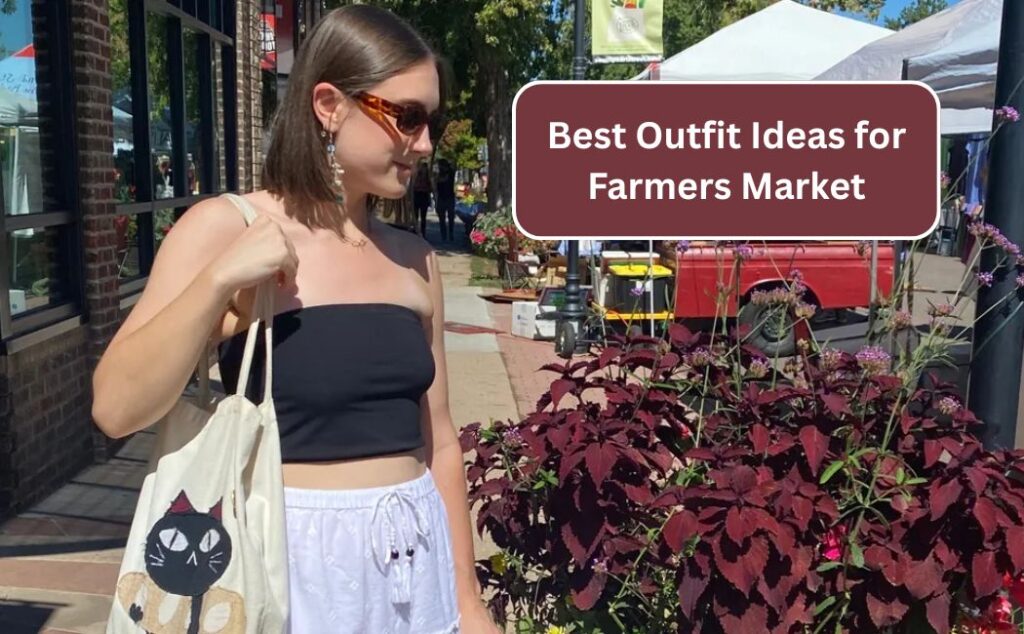
The tote bag. I cannot overstate how central this is. A great tote makes every outfit look more intentional — it’s the market equivalent of a handbag — and the right size and material matter. Canvas totes are practical and washable. Straw totes are more aesthetic but have less give. A woven market basket is beautiful and functional and slightly impractical (the rigid structure means things don’t stack easily). My personal recommendation: a large, structured canvas tote in natural or cream, big enough for serious produce hauls, sturdy enough that it doesn’t stretch into a misshapen blob by 11 AM.
The sunglasses. These are doing real optical work in a morning market (the Florida sun at 9 AM is not joking) and real aesthetic work in your outfit. An oversized frame in tortoiseshell, a classic aviator, or a rectangular vintage-inspired shape all work beautifully. Keep them on or pushed up on your head — either way, they’re part of the look.
The hat. A wide-brim straw hat is both practical (genuine sun protection for your face and neck) and aesthetically perfect for a morning market. Choose one with enough structure to stay put in light breezes. A baseball cap works just as well if the wide-brim feels like too much before 10 AM — it has a more casual, urban edge that works really well with the white-tee-and-jeans formula.
Gold earrings. One pair, medium weight, worn every week. Gold hoops — whether small and classic or slightly larger — add warmth and intention to any outfit without requiring any further thought. They’re the farmers market equivalent of a signature look.
A thin layering piece. For fall, winter, and spring mornings, this is essential. A lightweight cardigan, a denim jacket, a thin cotton shawl, or an oversized shirt worn as an open layer. Choose something you don’t mind tying around your waist when you inevitably warm up during the second hour. Keep it in the car if you’re not sure you’ll need it, but have it accessible.
What to Wear According to the Season?
The core principles stay constant through every season. The fabrics and layers adjust.
Spring is the most transitional and genuinely requires some layering strategy. Mornings can be cool (mid-60s in Florida, much cooler elsewhere), but by mid-morning, you can be standing in real warmth. A light denim jacket over a floral midi dress is ideal — you wear the jacket for the first thirty minutes, tie it around your waist for the rest. Lightweight jeans rather than shorts. A canvas bag. Maybe a thin scarf that can double as a wrap. Spring markets also have the best flowers, which is just worth noting.
Summer (and the long, sweltering season that starts in April and technically runs through October in Florida) demands maximum breathability. Linen maxi dresses. Linen sets. Cotton gauze. A tank top and linen wide-leg trousers. Anything that creates airflow. The hat becomes essential rather than optional. Sunscreen is not optional at any point in the year, but it’s especially urgent now — you are outside for two hours in direct sunlight. Your tote should be large enough that you’re not working up a sweat carrying it.
Fall is, honestly, the best time of year to dress for a farmers market — anywhere in the country, but especially in Florida, where October and November bring relief from the summer’s weight and a morning coolness that makes you want to be outside. This is when the cable-knit sweaters come out. When you can wear your slightly heavier denim. When a light cardigan pairs with literally everything. Ankle boots replace sandals. The straw tote gives way to a leather or canvas one. The color palette deepens — burnt orange, warm burgundy, caramel, and cream — and every one of those earthy tones photographs beautifully against the autumn market produce.
Winter market dressing is underrated in its coziness factor. In Florida, “winter” means layering a denim jacket over your dress and calling it done. In colder climates, it means a chunky cable-knit over slim pants, ankle boots with good grip, and a scarf you’ll eventually stuff in your bag. The farmers market doesn’t pause for weather, and neither should your style routine.
What Not to Wear (An Honest List)
This feels necessary because I have made every one of these mistakes personally, and some of them I made multiple times before I accepted the lesson.
Heels of any kind. Not even block heels, not even low wedges, not even platforms that feel stable. The surfaces at farmers markets — concrete, gravel, grass, damp pavement — are not wedge-heel-friendly, and you will be standing and walking for two hours. Your feet will stage a protest.
White or very light-colored bottoms. You will crouch near a wet table. You will brush against a tomato vendor’s display. You will sit on something without inspecting it first. White jeans at the farmers market are an optimistic gamble I no longer take.
Heavy synthetic fabrics. Anything that doesn’t breathe. Polyester blouses, thick athletic-material sets, and non-stretch heavy denim in summer. You will be warm and uncomfortable before the first full hour is up.
A bag that’s too small. If you arrive with a small crossbody and no tote, you’ll either not buy the things you want to buy, or you’ll leave with your arms full and your bag straining. Either outcome is unfortunate.
Very long, full, sweeping hems. A maxi dress is perfect. A dress with a dramatic train or a hem that touches the ground when you walk is not — it will catch on things, drag through puddles, and require your constant attention. A hem that skims the ankle or rests just above it is the sweet spot.
Final Thoughts
The farmers market is one of those places that rewards showing up. The food is better, the flowers are fresher, the morning is quieter, and the outfit feels more alive when you’re moving through it rather than just thinking about going. Dress for the experience you want to have, grab your tote, and go while the light is still low and gold.
If you’re in Sarasota, the downtown market runs every Saturday on Lemon Avenue — I’ll be the one debating between the sourdough and the olive bread and ultimately buying both. Come say hi. And if you want more on coastal living, seasonal style, and the particular joy of a well-dressed Saturday morning, subscribe to the Belle on the Boardwalk newsletter.
Welcome to my blog!
Meet Hannah Katherine, the creative voice behind Lifestyle, a blog dedicated to finding beauty and balance in everyday living. A former interior stylist turned full-time content creator, Sophie blends her love for cozy home design, mindful travel, and self-care into heartfelt stories that inspire readers to slow down and savor the little moments..