I still remember the first time I drove across the Sunshine Skyway Bridge, the long green cables fanning out above me like a harp against the Gulf sky. On one side: the sprawling, electric energy of St. Petersburg. On the other hand, just an hour south: the quieter, more curated elegance of Sarasota. Both cities sit on Florida’s Gulf Coast. Both have stunning white sand beaches, seafood restaurants that could make you cry, and that unmistakable salty warmth in the air. And yet, choosing between them is one of the most genuinely interesting decisions you can make as someone considering life on Florida’s west coast
I’ve spent real time in both. I’ve had morning coffee on Sarasota’s Siesta Key and evening cocktails on St. Pete’s Central Avenue. I’ve wandered the Ringling Museum on a Tuesday afternoon and stumbled into a gallery hop in downtown St. Pete on a Friday night. These are not the same person dressed in different clothes. They are two completely distinct personalities — and depending on who you are, one of them will feel like home in a way the other simply won’t.
This is not a list of facts. This is a genuine guide — the kind a friend who actually lives here would give you.
First, Understand What You’re actually comparing
Here’s something most comparison articles won’t tell you upfront: Sarasota and St. Petersburg are separated by about 75 miles by road, and they sit on opposite sides of Tampa Bay. You can’t “try both” easily on a weekend trip. They serve different life chapters, different budgets, and different versions of the Gulf Coast dream. Neither is objectively better. But for you, personally? One of them is almost certainly a much better fit.
Let’s get into it.
The Vibe: What Each City Actually Feels Like
Sarasota: The Cultural Sophisticate
Pull into Sarasota, and something shifts in the air almost immediately. The city moves a little slower, breathes a little deeper. The streets downtown are lined with palm trees and boutique storefronts, and there’s an almost European sense of intention to how the city has arranged itself around the arts. Sarasota wears the nickname “Florida’s Cultural Coast” with complete sincerity — this isn’t marketing fluff. The city genuinely built its identity around culture.
Walking through downtown on any given evening, you’ll pass the Sarasota Opera House, theaters from the historic Florida Studio Theatre (which has been shaping the city’s artistic scene since 1973), and gallery after gallery of serious fine art. There are 13 performance stages within a single mile of downtown — a fact that’s almost absurd when you say it out loud. The arts here aren’t a weekend hobby; they’re woven into the fabric of the city.
The energy skews a bit older, calmer, and more refined. That’s not a criticism — it’s part of what makes Sarasota feel like a place where people have genuinely chosen to live intentionally. You’ll see a lot of couples in their 40s and 50s, retirees who are deeply engaged in the community, and remote workers who relocated from bigger cities seeking a quieter kind of beauty. The pace is deliberate. The restaurants are excellent and uncrowded. The mornings on the beach are something close to sacred.
St. Petersburg: The Creative Urban Adventurer
St. Pete hits differently — and I mean that in the best possible way. Walk down Central Avenue on a Thursday evening, and you’ll understand immediately: this city has energy. Street art wraps around buildings. A jazz bar spills music onto the sidewalk. A rooftop crowd watches the sun melt into Tampa Bay. St. Pete is Florida’s most interesting small city, and it knows it.
Downtown St. Pete has undergone a remarkable transformation over the past decade into one of the most walkable, vibrant urban neighborhoods on Florida’s entire coast. The bar scene alone is something to see — from the 70s disco bliss of Good Night John Boy to the steampunk-Victorian elegance of Club 201 tucked inside the historic Detroit building to Tequila Daisy’s cathedral of 500+ agave spirits. Every block has a personality.
The demographics are younger and more diverse than those in Sarasota. You’ll find creatives, tech workers, young families, and longtime locals all coexisting in a city that genuinely feels proud of itself without being smug about it. The art scene — anchored by the world-famous Dalí Museum — runs deep and wide, but it has a scrappier, less polished energy than Sarasota’s. Gallery hops, street murals, pop-up markets, and indie coffee shops that double as record stores. St. Pete feels alive in a way that’s electric rather than elegant.
The Beaches: A Tale of Two Coastlines
Sarasota’s Secret Weapon: Siesta Key
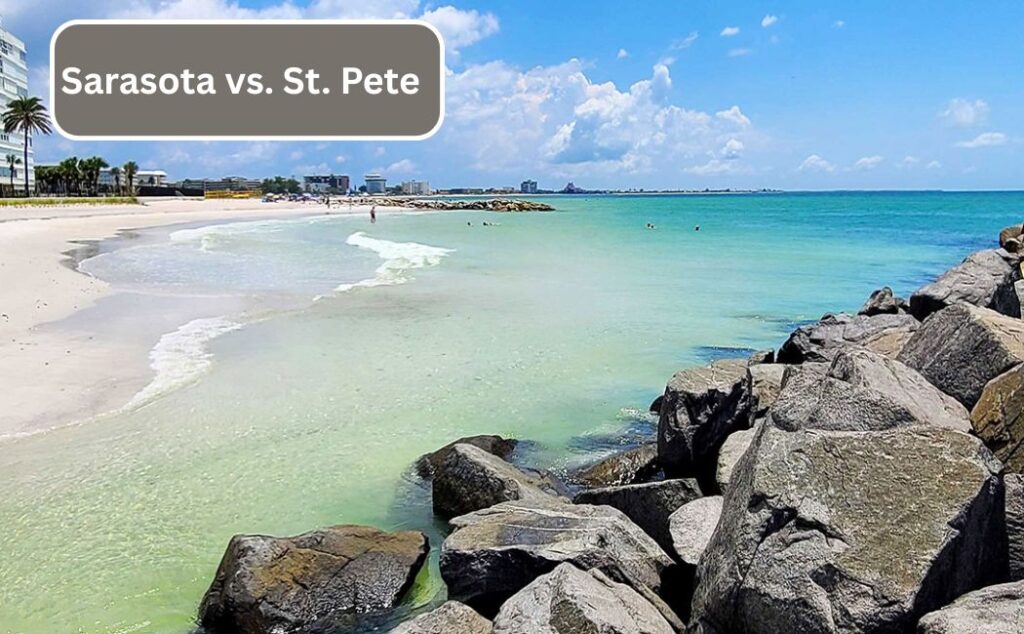
If you ever needed one piece of evidence that Sarasota takes beaches seriously, it’s this: Siesta Key Beach has been rated the #1 beach in the United States and #4 in the world as recently as 2025. That’s not a fluke. The sand on Siesta Key is composed of 99% pure quartz crystal — it stays cool even at the height of summer, it squeaks underfoot, and it has a softness that’s almost hard to believe. Sitting on Siesta Key beach at golden hour, with that powder-white sand glowing in the fading light, is genuinely one of those travel experiences that stays with you.
Beyond Siesta Key, Sarasota offers Lido Beach (connected to the charming St. Armands Circle shopping district), Crescent Beach, Turtle Beach, and the kayak-friendly mangrove waterways of Lido Key. Beach access is free and plentiful throughout Sarasota County, which matters more than you might think — no parking passes required.
What Sarasota’s beach experience offers is intimacy. You don’t have to drive far or fight crowds on most days. A beach trip is a casual, everyday kind of thing, not a weekend production.
St. Pete’s Beach Diversity: 20+ Miles of Variety
St. Pete counters with something different: sheer range. Spread across more than 20 miles of coastline, the Pinellas County beach communities each have their own personality, and collectively they form one of the most diverse beach experiences anywhere in the country.
Fort De Soto Park, at the southern tip, is wild and natural — seven miles of undeveloped shoreline, a dog beach, campgrounds, and an old Spanish-American War fort to explore. It’s the kind of beach that feels like you found something secret. Moving north, St. Pete Beach offers the classic Florida beach resort experience: wider sand, beachfront hotels, parasailing, jet ski rentals, and beach bars. Madeira Beach clusters around John’s Pass Village, a boardwalk of shops and seafood restaurants that has a genuine old-Florida charm. Further up, Clearwater Beach — though technically part of Clearwater rather than St. Pete proper — is consistently rated among America’s best and is stunning in its own right.
The honest trade-off: St. Pete’s sand doesn’t match Siesta Key’s legendary quality. But the variety and the journey through different beach towns make for a genuinely different kind of beach life — one that’s more about exploration than perfection.
Bottom line on beaches: If you want the world’s best single beach, Sarasota wins. If you want variety and the freedom to discover a new waterfront on every outing, St. Pete wins.
The Arts & Culture Scene
Sarasota: Depth, Prestige, and Institutional Gravity
This is where Sarasota has a significant edge for those who care about arts and culture at a serious level. The city’s arts infrastructure is genuinely remarkable for its size. The Ringling — formally the John and Mable Ringling Museum of Art — houses one of the great collections of Baroque art in the United States, set on 66 acres overlooking Sarasota Bay. The Sarasota Art Museum, affiliated with Ringling College of Art and Design, runs a serious exhibition calendar that includes major contemporary artists and traveling shows from institutions like the Wolfsonian at FIU. The Van Wezel Performing Arts Hall brings Broadway touring productions and major musicians. Asolo Repertory Theatre is one of the most acclaimed regional theater companies in the Southeast.
The 2025–2026 season has been particularly active. The Living Arts Festival brings performing arts, music, dance, and visual art across venues from downtown to Venice. The Arts and Cultural Alliance’s new Talkback Tuesdays series gives residents genuine access to artists and cultural leaders. Sarasota Opera presents full-season programming at an Opera House that is itself worth visiting just for the architecture.
This is a city where the arts are not entertainment — they’re infrastructure.
St. Pete: Bold, Accessible, and Street-Level
St. Pete’s cultural scene is louder, more democratic, and in many ways more innovative. The anchor is the Dalí Museum — the largest collection of Salvador Dalí’s work outside of Europe, housed in a stunning building designed with a geodesic glass atrium called “the enigma.” It’s genuinely spectacular and worth the trip alone.
Beyond Dalí, St. Pete has built one of Florida’s richest street art cultures, with massive murals covering entire building facades across the urban grid. The Imagine Museum focuses on contemporary studio glass. The Florida Holocaust Museum is one of the largest in the Southeast. The James Museum of Western and Wildlife Art is a world-class collection in a beautiful building. And running through all of it is a gallery culture and First Friday gallery walk scene that gives the arts a casual, approachable street-level energy that Sarasota’s more formal institutions sometimes lack.
For people who want their culture to meet them where they are — on a walk, over a beer, between errands — St. Pete delivers.
Cost of Living & Housing: The Real Talk
This is where things get very practical and very different between the two cities.
Housing Costs
Sarasota’s real estate market runs meaningfully higher than St. Pete’s. Median home prices in Sarasota hover around $450,000–$525,000, depending on the area and time of year, with anything on or near the barrier islands (Siesta Key, Lido Key) pushing significantly higher. It’s a city that has become increasingly expensive as its reputation has grown.
St. Pete runs roughly 20–30% cheaper across comparable properties. Median home prices sit around $350,000–$420,000, with downtown and waterfront neighborhoods like Old Northeast and Snell Isle commanding premiums but still generally undercutting Sarasota’s equivalent. If you’re renting, a one-bedroom in St. Pete typically runs $1,500–$1,700 per month, while Sarasota trends closer to $1,900–$2,100.
Overall, the cost of living in St. Petersburg runs about 2–3% lower than Sarasota, which may sound modest but adds up meaningfully over time.
The Value Calculation
What makes this comparison interesting is that more money in Sarasota often buys you a more suburban, spacious lifestyle — newer developments, single-family homes, quiet neighborhoods with top-tier schools. More money in St. Pete buys you urban density, walkability, and access to a social and cultural ecosystem that you’d otherwise have to drive to.
Neither is a better deal objectively. They’re just different trades.
Schools & Families
For families with children, Sarasota has a meaningful advantage on paper. Sarasota County Schools have earned an A-grade from the state of Florida for 22 consecutive years — a record that’s genuinely hard to match. Pine View School, a public gifted program, is ranked the #1 public school in Florida and consistently appears on national lists. The consistency across the district is high.
Pinellas County (St. Pete’s district) has improved significantly, achieving an A rating in 2024, and offers excellent magnet and fundamental school programs. The variance between individual schools is somewhat higher than Sarasota, which means neighborhood research matters more when you’re choosing where to live.
For families prioritizing school quality as a near-non-negotiable, Sarasota has the historical edge. For families who can navigate school choice and are more focused on the overall lifestyle environment, St. Pete’s urban neighborhood family culture — particularly in areas like Historic Kenwood, Crescent Lake, and Old Northeast — is wonderful.
Food & Restaurants
Sarasota: Farm-to-Table Refinement
Sarasota’s food scene punches well above its population weight. The city has attracted serious chefs who value a slower-paced community with a sophisticated clientele. Fine dining is genuinely excellent — you can eat as well in Sarasota as you can in most major American cities, without the reservation madness or the attitude. The Saturday morning Farmers Market on Lemon Avenue has become a beloved institution, with local produce, artisan food vendors, and a social energy that makes it worth attending even if you don’t need groceries. St. Armands Circle on Lido Key adds a curated dining and shopping strip that’s postcard-pretty.
The vibe is elevated without being pretentious. You’ll find farm-to-table menus using Gulf catch, excellent wine programs, and a strong brunch culture.
St. Pete: More Variety, More Edge
St. Pete’s food scene is larger and more diverse by virtue of being a bigger city. Central Avenue alone contains an impressive range: Vietnamese, Ethiopian, vegan spots, raw bar-forward seafood restaurants, craft cocktail bars with serious food programs, and coffee shops good enough to anchor a whole morning. The Sundial area adds outdoor dining with a more polished, curated feel.
The craft beer scene is particularly strong — St. Pete has become one of Florida’s craft brewery hubs, with 3 Daughters Brewing, Green Bench Brewing, and Cycle Brewing among a cluster of well-regarded local operations. For food adventurers who want to graze across a variety of cuisines and styles, St. Pete has more runway.
Getting Around & Location
This is a practical factor that people underestimate until they’re living it.
St. Pete is significantly better positioned for people who travel frequently or need easy access to a major airport. Tampa International Airport is roughly 20–30 minutes from downtown St. Pete — one of the easiest airport commutes of any major Florida city. Sarasota has its own Sarasota-Bradenton International Airport, which has improved considerably but still offers fewer direct routes. Tampa is 60–90 minutes from downtown Sarasota, depending on traffic, which adds friction if you’re flying regularly.
Within the city itself, St. Pete is walkable in ways that Sarasota simply isn’t. Downtown St. Pete lets you genuinely live car-lite — coffee, grocery, restaurants, the beach — all within walking or biking distance in the right neighborhood. Sarasota is a more car-dependent city by design, which is fine if you prefer that lifestyle, but it is worth knowing in advance.
The Social Scene by Life Stage
This is the piece that’s hardest to quantify but maybe the most important.
Sarasota tends to fit: Couples and families who prioritize quiet elegance, serious arts engagement, excellent schools, and a pace of life that doesn’t demand constant stimulation. Retirees who want a genuinely culturally rich environment without urban noise. Remote workers who crave beauty and calm as the backdrop to a focused life. Anyone drawn to the coastal grandmother aesthetic in the most lived-in, authentic sense of it.
St. Pete tends to fit: Young professionals and creatives who want urban energy without a major city’s cost or chaos. Couples in their 30s who want to walk to dinner, explore a new neighborhood bar, and feel genuinely embedded in a community that has a distinct, proud identity. People who are energized by variety — in food, in culture, in the mix of people around them. Anyone who loved the energy of a bigger city but wanted Gulf Coast water and sunshine as their backdrop.
That said, these aren’t hard rules. I know families who love St. Pete’s neighborhood character and retirees who’ve never felt more alive than they do in downtown St. Pete. And I know young people who chose Sarasota specifically because they wanted the arts and the quiet. Know yourself, and let that be your guide.
The Honest Quick-Take: Who Should Choose What
Choose Sarasota if:
- The world’s best beach (Siesta Key) is a genuine priority for you
- You value a deeply established, prestigious arts and cultural ecosystem
- Top-tier public schools are near the top of your list
- You’re drawn to a quieter, more refined pace of coastal life
- You’re okay spending more for more space, better schools, and established prestige
Choose St. Pete if:
- You want a walkable, urban lifestyle with genuine nightlife and variety
- A lower price point matters (and it matters more than you might expect over time)
- You fly frequently and want a quick airport commute
- You’re drawn to a younger, more creative, more diverse community
- You want to explore a different beach or neighborhood every weekend
A Personal Note
After everything, here’s what I’ll say: both cities gave me something I’ll carry with me. Sarasota gave me mornings so quiet and beautiful that they almost don’t feel real — beach walks before the tourists arrive, a cup of coffee at a farmers market that felt like a conversation with the community. St. Pete gave me nights that crackled with the particular energy of a city figuring out what it wants to become, which is one of the most exciting things you can be part of.
You can’t be in two places at once. But you can visit the other one easily enough for a day trip or a long weekend — and I’d encourage you to do exactly that before you commit. Drive the Skyway. Sit in both downtowns. Eat in both cities. Stand at the edge of the Gulf in both places and see which one makes you think: yes. This is where I want to be.
Because that feeling? It’s the only comparison tool that actually matters.