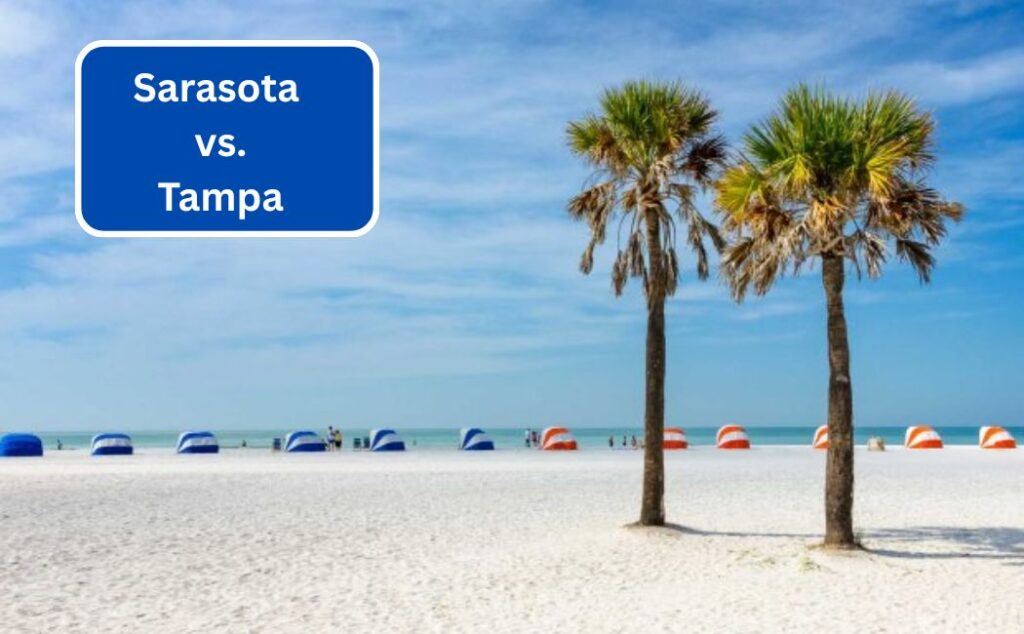
Sarasota for beaches, arts, and a slower coastal pace. Tampa for urban energy, sports, nightlife, and big-city variety. But here’s what nobody tells you: they are 60 minutes apart on I-75, and the smartest Florida trip uses both. This guide tells you exactly how.
Here is the question I should be answering before I answer the question in the title:
Why are you choosing?
I live in Sarasota. I drive to Tampa regularly — for concerts at Amalie Arena, for games at Raymond James Stadium, for Tampa International Airport (one of the genuinely best airports in the United States, a fact that still surprises people), and occasionally just for the specific kind of evening that a proper city provides when a small coastal city doesn’t quite have it.
Ryan and I made our home in Sarasota because Sarasota is extraordinary. But we use Tampa the way people in Brooklyn use Manhattan — as the city that’s close enough to access whenever you need what it offers, far enough to make home feel like an escape rather than an extension of urban life.
That relationship — Sarasota and Tampa as a pair rather than a competition — is the thing this comparison guide is actually about.
Most Sarasota vs Tampa posts treat these cities as a binary choice. But they sit 60 miles apart on the same Gulf Coast corridor, connected by one of the most straightforward highway drives in Florida. They serve entirely different purposes for the traveler who knows both, and the right question isn’t “which one” — it’s “which one do I base myself in, and when do I drive to the other?”
Here is the full honest comparison. And then the two-city strategy that most visitors never consider but should.
The 30-Second Overview
| Factor | Sarasota | Tampa |
|---|---|---|
| Population | ~60,000 city / 910K metro | ~385,000 city / 3.3M metro |
| Best beach | Siesta Key (#1 U.S. beach 2026) | Clearwater Beach (~45 min away) |
| Median home price | ~$460,000 | ~$340,000–$380,000 |
| Cost of living index | ~105 (5% above national avg) | ~94.6 (5.4% below national avg) |
| Nightlife | Moderate | Strong — Ybor City, downtown, SoHo |
| Arts & culture | Exceptional for city size | Good — larger scale |
| Sports teams | None major | NFL (Bucs), NHL (Lightning), MLB (Rays) |
| Airport | SRQ (15 min from downtown) | TPA (one of the best in the U.S.) |
| Best for visitors | Beach, arts, coastal calm | Urban energy, sports, variety |
| Best for residents | Coastal lifestyle, schools, quiet | Jobs, career, big-city amenities |
| Distance from each other | 60 miles — 70 minutes on I-75 |
The Vibe: Two Cities That Could Not Feel More Different
Sarasota: Small, Intentional, Quietly Extraordinary
Sarasota doesn’t feel like Florida. I mean this as a compliment.
Most Florida cities feel like they happened — like the growth preceded the character, and the character is still catching up. Sarasota feels like it was decided. Someone looked at this Gulf Coast location and chose to build something specific: a city oriented around arts, beauty, and a quality of life that doesn’t require constant stimulation.
The evidence of that decision is everywhere. The Ringling Museum — Florida’s State Art Museum, on a 66-acre bayfront estate — would be remarkable in a city five times the size. The Sarasota Farmers Market on Lemon Avenue has run every Saturday since 1979. The drum circle at Siesta Key Beach has gathered organically every Sunday sunset since 1996. Marie Selby Botanical Gardens is the world’s first net-positive energy botanical complex. Asolo Repertory Theatre is one of the most acclaimed regional theater companies in the Southeast.
This is what a city of 60,000 people built. It is extraordinary.
The pace reflects this intentionality. Sarasota moves more slowly than Tampa. The streets empty earlier. The mornings are quieter. The conversation at the farmers market lingers. This isn’t a city that’s always rushing somewhere — and that specific quality, which frustrates some visitors and deeply satisfies others, is the most honest thing I can say about what Sarasota actually is.
Tampa: Real, Diverse, Genuinely Urban
Tampa surprised me the first time I visited after moving to Sarasota. I had expected something generic — a medium-large Florida city with highways and chain restaurants and the particular anonymity of sprawl. What I found instead was a city with genuine neighborhoods, a remarkable food culture, a waterfront that’s been thoughtfully developed, and a downtown that actually functions as a downtown rather than as a collection of office buildings that empty at 5 PM.
Tampa is one of the best food cities in the country. That’s not local bias — it’s the consistent verdict of national food media. Bern’s Steak House is a national institution. The Cuban food in Ybor City is the authentic article, descended from the Cuban cigar workers who built the neighborhood in the 1890s. The Oxford Exchange, the Armature Works food hall, the restaurants of Hyde Park — Tampa’s dining culture has genuine depth and diversity that Sarasota, at its smaller scale, simply doesn’t match.
The Riverwalk along the Hillsborough River is one of the better urban waterfront experiences in Florida — 2.6 miles of connected walkway linking museums, restaurants, and parks in a way that makes the city genuinely walkable in its core. The Tampa Museum of Art, the Florida Aquarium, the Tampa Bay History Center — the cultural infrastructure is there, at a larger scale than Sarasota’s, even if it doesn’t have Sarasota’s depth per square mile.
And Ybor City. I want to give Ybor City its own paragraph because it is genuinely one of the most historically interesting and atmospherically distinct urban neighborhoods in Florida. The Victorian architecture, the old cigar factory buildings repurposed into clubs and restaurants, the free-roaming chickens (this is real), the Latin cultural heritage that still permeates the restaurants and the music — Ybor has a character that no other Florida neighborhood I’ve visited quite replicates.
The Beaches: A Genuinely Lopsided Comparison
This is the most important comparison for visitors who are primarily beach-motivated, and the most honest answer is: Sarasota wins, decisively.
Siesta Key Beach is ranked the #1 beach in the United States in 2026 by both U.S. News & World Report and TripAdvisor’s Travelers’ Choice Awards. The sand is 99% pure quartz crystal — it stays cool in Florida summer heat, glows brilliant white, and has a softness that genuinely needs to be experienced. The Gulf water is warm, calm, and clear. This is the world’s best beach, and it is fifteen minutes from Sarasota’s downtown.
Tampa does not have a comparable beach. Tampa Bay itself — the large inlet that the city sits on — is not a swimming beach. The nearest genuinely good beaches are Clearwater Beach (ranked #2 in the U.S. for 2026) and St. Pete Beach, both approximately 30–45 minutes from downtown Tampa via the Howard Frankland Bridge or the Courtney Campbell Causeway. These are excellent beaches — Clearwater Beach specifically is one of the finest on the Gulf Coast — but they require the drive, and the drive adds friction that Sarasota’s beach proximity doesn’t.
If beaches are the primary reason you’re visiting Florida, base yourself in Sarasota. Full stop.
Arts, Culture, and What To Do Indoors
Sarasota: Depth Per Square Mile That Defies Its Size
The number that always stops people: Sarasota has 13 performing arts stages within one mile of its downtown. In a city of 60,000.
The cultural infrastructure — The Ringling, Sarasota Art Museum, Marie Selby Botanical Gardens, Mote SEA Aquarium, Florida Studio Theatre, Asolo Repertory Theatre, the Sarasota Opera — represents decades of deliberate investment in the arts as civic infrastructure rather than entertainment supplement. The per-capita arts density here is comparable to cities ten times the size.
The visitor experience reflects this: the cultural calendar in Sarasota has something worth attending virtually every week of the year. The Ringling’s Summer Circus Spectacular. Sarasota Film Festival. Sarasota Music Festival. The Florida Studio Theatre’s comedy and drama seasons. For a visitor who cares about arts and culture as a meaningful part of a trip, Sarasota delivers more concentrated quality than most people expect.
Tampa: Scale and Sports That Sarasota Can’t Match
Tampa’s cultural offerings are larger in scale if somewhat less dense in quality-per-experience. The Tampa Museum of Art, Straz Center for the Performing Arts, Tampa Bay History Center, Florida Aquarium, and the Henry B. Plant Museum (inside the genuinely extraordinary 1891 Tampa Bay Hotel, now the University of Tampa campus) all provide genuine cultural substance.
But Tampa’s distinctive cultural offering — the one that has no Sarasota equivalent — is sport.
The Tampa Bay Buccaneers play at Raymond James Stadium. The Tampa Bay Lightning play at Amalie Arena, where they have won three Stanley Cup championships since 2004, and where the atmosphere on a playoff night is something genuinely memorable. The Tampa Bay Rays, historically one of baseball’s most analytically interesting franchises, currently play at Tropicana Field in St. Pete while their new stadium is being developed. And USF Bulls football, Tampa Bay Rowdies soccer, and the consistent draw of major concerts and events at both arenas give Tampa an events calendar that Sarasota simply doesn’t have.
I have driven to Tampa for a Lightning game twice. Both times it was worth it.
Food and Nightlife: Tampa’s Strongest Argument
Tampa Wins This Comparison Honestly
Tampa is consistently ranked among the top food cities in the country, and it earns that ranking through genuine diversity and quality rather than marketing. The food culture here is anchored by its history — the Cuban, Spanish, and Italian immigrant communities that built Ybor City in the 1890s left a culinary inheritance that Tampa restaurants still draw from a century later.
The Columbia Restaurant in Ybor City — opened in 1905, the oldest restaurant in Florida, the largest Spanish restaurant in the world — is worth a visit purely as a cultural institution, separate from the genuinely excellent food. The Cuban sandwich debate is real and local: Tampa’s version (with Genoa salami, a reflection of the Italian community) differs from Miami’s version, and Tampa’s is historically correct by its own city’s logic.
Beyond the historic: Bern’s Steak House has one of the largest wine collections in the world and a steakhouse experience that national food critics have been writing about for decades. The Armature Works food hall in the Heights neighborhood has some of the best casual dining variety in the state. Oxford Exchange is a bookstore-restaurant combination of such specific beauty that it has become one of the most photographed interiors in Tampa.
Sarasota’s food scene is genuinely excellent — Owen’s Fish Camp, Selva Grill, Ophelia’s on the Bay are all world-class in their way. But the range and diversity of Tampa’s dining, across price points and cuisines, is broader.
Nightlife: Not Even Close
Tampa has genuine nightlife. Ybor City on a weekend night is one of the most energetically distinct entertainment districts in Florida — bars and clubs in historic brick buildings, live music spilling into the street, the specific chaos of a neighborhood that’s been a nightlife destination since before Florida had highways. SoHo (South Howard Avenue in Hyde Park) is Tampa’s upscale bar corridor. Downtown and the Channel District have the newer, more polished options.
Sarasota’s nightlife is good for its size — Main Street, Siesta Key Village, the waterfront bars — but it is modest compared to Tampa’s. The city goes quieter after 10 PM in most areas. For anyone whose trip requires significant nightlife, Tampa is the answer.
Cost: The Numbers That Might Change Your Plans
Tampa’s cost of living index is 94.6 — about 5.4% below the national average. Sarasota’s cost of living index is approximately 105, making it 5% above the national average and roughly 11% more expensive than Tampa.
This gap shows up most significantly in accommodation. A mid-range hotel in downtown Tampa can run $150–$220 per night. Comparable Sarasota accommodations, particularly near the beach, run $200–$350. Vacation rentals follow similar patterns.
Median home prices in the greater Sarasota area tend to be higher than Tampa Bay by roughly $100,000 — a meaningful gap that reflects both the beach proximity premium and Sarasota’s more limited housing supply.
For a visitor making a budget decision, Tampa gives you more city for less money. Sarasota gives you better beaches and arts for a modest premium. The right choice depends on what you’re optimizing for.
The Two-City Strategy: What Nobody Else Will Tell You
Here is the framework I use personally, and what I recommend to every friend who asks:
Use Sarasota as your base. Use Tampa as your day trip.
The drive from Sarasota to downtown Tampa is approximately 60–70 minutes on I-75 North — a straightforward highway drive with no complicated navigation. You leave Sarasota in the morning, spend the day in Tampa (Ybor City for lunch, a museum or game, dinner in Hyde Park, back on the road by 9 PM), and wake up the next morning fifteen minutes from the world’s best beach.
This approach gives you everything:
- The best beach in America is your daily option
- Sarasota’s arts and cultural infrastructure as your backdrop
- Tampa’s food, sports, nightlife, and urban energy as a scheduled day trip
- Tampa International Airport (TPA) as your flight hub — 60 minutes from Sarasota, and genuinely one of the best airports in the United States
The reverse also works — Tampa as base, Sarasota as day trip — but I’d argue it works less well, because Siesta Key Beach as a day trip requires the early morning beach strategy to be worthwhile, and that’s harder to execute from a city base 70 minutes away.
The specific trips where each city wins as the solo destination:
Base in Sarasota when:
- Beach quality is the primary driver
- You want arts, culture, and museums as primary activities
- You’re traveling with family and the Mote SEA Aquarium, Sarasota Jungle Gardens, and Ringling Circus Museum are on the list
- You want a quieter, more residential experience of Florida
- You’re moving to the area and evaluating the lifestyle
Base in Tampa when:
- You’re attending a specific sporting event or concert at Amalie Arena or Raymond James
- Nightlife is a significant trip priority
- Budget is the primary constraint (Tampa accommodation runs meaningfully cheaper)
- You’re arriving via TPA and want to explore without a long initial drive
- You want the full diversity of a genuine American city as your primary experience
Frequently Asked Questions
Q: Is Sarasota or Tampa better to visit?
A: For beaches and arts, Sarasota. For nightlife, sports, and urban variety, Tampa. They’re 60 minutes apart — the smartest trip uses both.
Q: How far is Sarasota from Tampa?
A: About 60 miles — roughly 60–70 minutes on I-75 South. Straightforward highway drive with no toll roads required.
Q: Which has better beaches — Sarasota or Tampa?
A: Sarasota, decisively. Siesta Key is the #1 beach in the U.S. Tampa’s nearest good beaches (Clearwater, St Pete Beach) are 30–45 minutes from downtown Tampa.
Q: Is Tampa or Sarasota cheaper?
A: Tampa. Cost of living index 94.6 vs Sarasota’s 105 — Tampa runs roughly 11% cheaper overall, with meaningfully lower accommodation and home prices.
Q: Is Sarasota or Tampa better for families?
A: Sarasota for beach families and school quality (22 consecutive A-rated years). Tampa for families who want sports, Busch Gardens, and big-city variety alongside Florida living.
Q: Which has better nightlife — Sarasota or Tampa?
A: Tampa, significantly. Ybor City alone provides a nightlife district with no Sarasota equivalent. SoHo and downtown add to a substantial evening scene.
Q: Which is better for a long weekend trip?
A: Base in Sarasota for the beach, do a Tampa day trip on day two. You get the world’s best sand and a genuine city experience in three days without choosing between them.
Q: What does Tampa have that Sarasota doesn’t?
A: NFL football (Bucs), NHL hockey (Lightning), MLB baseball (Rays), Ybor City’s historic nightlife district, Michelin-level food diversity, Tampa International Airport, and a significantly larger urban scale.
Q: What does Sarasota have that Tampa doesn’t?
A: The #1 beach in the United States (Siesta Key), the Ringling Museum on a bayfront estate, the Sunday drum circle, the world’s finest sand, Marie Selby Botanical Gardens, and the specific quality of a small city that has decided to take arts and coastal life seriously.
Q: Should I fly into Tampa or Sarasota?
A: Tampa International Airport (TPA) is one of the best airports in the U.S. — consistently rated among the most efficient, easiest to navigate, and well-connected. Sarasota-Bradenton International (SRQ) has expanded its routes significantly and is extremely convenient (15 minutes from downtown Sarasota). If you’re basing yourself in Sarasota, SRQ is faster and easier. If you’re doing the two-city strategy, TPA’s better flight options often justify the 60-minute drive.
Honest One-Line Answer
Visit Sarasota if you want the best Gulf Coast beach experience anchored by genuine arts, culture, and coastal calm.
Visit Tampa if you want an actual city with sports teams, a legendary food scene, and nightlife that runs past 10 PM.
Visit both if you have four or more days and a car. They are sixty minutes apart and genuinely complementary.

Welcome to my blog!
Meet Hannah Katherine, the creative voice behind Lifestyle, a blog dedicated to finding beauty and balance in everyday living. A former interior stylist turned full-time content creator, Sophie blends her love for cozy home design, mindful travel, and self-care into heartfelt stories that inspire readers to slow down and savor the little moments..