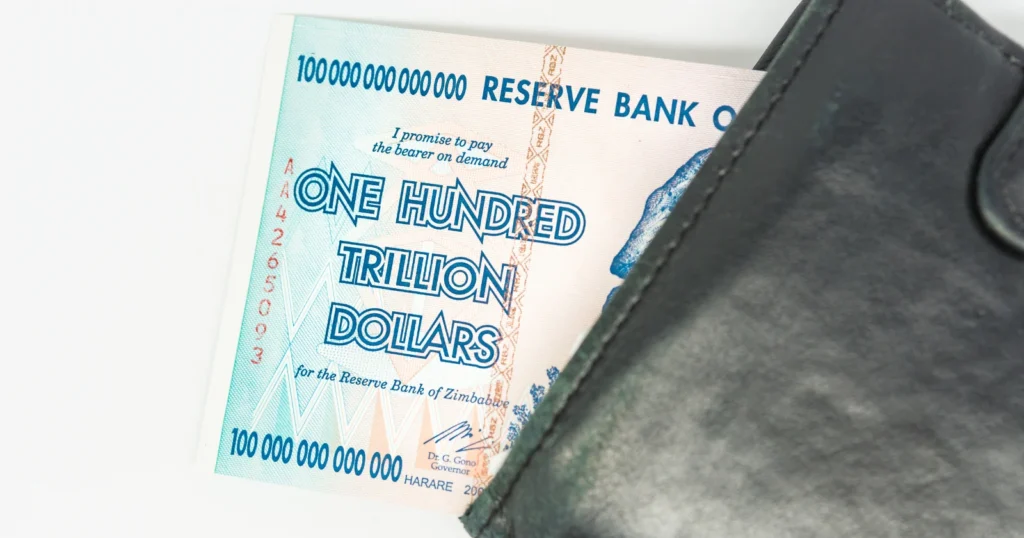
Imagine walking into a store with a suitcase full of cash, only to find that your fortune is now worthless. This wasn’t a scene from a dystopian film—it was daily life in Zimbabwe during 2008, when the nation experienced one of history’s most catastrophic economic collapses.
At the height of the crisis, prices weren’t rising by the week or even the day. They doubled every 24 hours. The government’s response? Print a hundred-trillion-dollar banknote that could barely buy a loaf of bread.
This isn’t just a story about failed economics. It’s a cautionary tale about what happens when governments lose control of the money supply, and how ordinary citizens become victims of decisions made in distant boardrooms.
When Money Stops Being Money
In 2008, Zimbabwe’s currency had become a punchline in global financial circles. The Reserve Bank of Zimbabwe, desperately trying to inject liquidity into a collapsing economy, made a fateful decision: keep printing money. The logic seemed simple—more cash would stimulate spending and economic activity. The result was the opposite.
As the central bank flooded the market with new notes, each unit of currency became progressively less valuable. Shopkeepers couldn’t keep up with the pace of devaluation. Price tags became obsolete within hours. Some stores simply stopped listing prices altogether and negotiated in real-time based on the current black market exchange rate.
The fundamental problem was a disconnect between money supply and economic output. Zimbabwe’s productive capacity had collapsed due to political turmoil, land seizures, and international sanctions. Yet the printing presses worked overtime, creating money divorced from any tangible economic value.
| Time Period | Inflation Rate | Currency Denomination Introduced | Actual Value (USD) |
|---|---|---|---|
| January 2008 | 24,411% | 100 Million ZWD note | ~$5-10 |
| April 2008 | 2,200% | 500 Million ZWD note | ~$2-3 |
| July 2008 | 231,000,000% | 100 Billion ZWD note | ~$0.50 |
| October 2008 | 89,700,000,000,000% | 100 Trillion ZWD note | ~$30 |
| December 2008 | Incalculable | Currency abandoned | Zero |
The Hundred Trillion Dollar Note: A Symbol of Collapse
The Reserve Bank of Zimbabwe’s hundred-trillion-dollar note became the ultimate symbol of economic failure. Collectors now prize these notes as historical curiosities, yet when first introduced in October 2008, they represented something far grimmer: the admission that the currency system had completely broken down.
Think about the mathematics for a moment. A hundred trillion dollars sounds incomprehensibly large. Yet on the street, this note exchanged for approximately thirty US dollars—and even that value was optimistic. Within days, it was worth far less. Within weeks, it was essentially worthless paper.
The irony was painful for ordinary Zimbabweans. The central bank had finally created a note large enough to address daily transactions, but by the time it hit circulation, inflation had rendered it quaint. Workers who received their salaries in these notes found themselves unable to afford basic necessities. A hundred trillion dollars couldn’t buy a chicken or a tank of petrol.
“The hundred-trillion-dollar note wasn’t a solution—it was a symptom of a currency in its death throes. It represented the central bank’s complete loss of monetary control,” says Dr. Michael Hannover, financial historian at Oxford University.
What makes this note particularly fascinating is how it has become a collector’s item worth far more than its original face value. Today, in pristine condition, a hundred-trillion-dollar note can sell for $20-40 USD to numismatists—making it genuinely valuable only after it became worthless as currency.
How Daily Life Became Impossible
For ordinary Zimbabweans, hyperinflation wasn’t an abstract economic concept. It was a daily battle for survival. Workers woke up knowing that their paycheck would lose 50% of its purchasing power by lunchtime. Shopkeepers faced an impossible dilemma: accept payment in official currency that was dying by the hour, or refuse to sell entirely.
Public sector employees—teachers, nurses, police officers—found that their salaries could barely purchase a single day’s groceries. Some abandoned their jobs to pursue survival trading in the informal economy. Teachers with advanced degrees became street vendors. Nurses worked part-time in private clinics that paid in stronger currencies. The professional class effectively ceased to exist.
Families developed survival strategies. Some pooled resources to buy goods in bulk, hoping to resell them before prices doubled again. Others abandoned the Zimbabwean dollar entirely and conducted all transactions in South African rand or US dollars obtained through the black market. Trust in the official currency had completely evaporated.
| Item | Price (June 2008) | Price (August 2008) | Price (October 2008) | Change Factor |
|---|---|---|---|---|
| One Loaf of Bread | 100 Million ZWD | 500 Million ZWD | 5 Billion ZWD | 50,000x increase |
| Dozen Eggs | 200 Million ZWD | 1 Billion ZWD | 10 Billion ZWD | 50,000x increase |
| One Kilogram Maize Meal | 150 Million ZWD | 800 Million ZWD | 8 Billion ZWD | 53,000x increase |
| One Liter Petrol | 500 Million ZWD | 3 Billion ZWD | 40 Billion ZWD | 80,000x increase |
The Black Market Thrives While the Official Economy Dies
As the Zimbabwean dollar became increasingly worthless, an ironic inversion occurred: the black market became the real economy. Those who had access to foreign currency—whether through family connections abroad, previous savings, or illicit means—held power. Those trapped with only official currency faced destitution.
Street traders became the true price discoverers. They continuously adjusted exchange rates based on real-time supply and demand, reflecting actual currency values far more accurately than any official rate. A Zimbabwean dollar that officially exchanged for 1:25,000 USD might trade at 1:500,000 on the street. The government’s fictional official rates became irrelevant.
Corruption flourished in this environment. Officials with access to foreign currency allocations could trade at official rates and pocket massive profits by reselling at black market rates. Fuel shortages were weaponized—government cronies received allocations of petrol and diesel, which they immediately sold at enormous markups. The poor stood in queues for hours hoping to obtain rationed fuel at twice the already-inflated prices.
“In hyperinflationary environments, the black market isn’t a symptom of corruption—it becomes the only functioning market mechanism. Government prices are so disconnected from reality that honest commerce becomes impossible,” explains Professor Sarah Chen, monetary economist at the University of Cape Town.
Remittances from family members abroad became lifelines. A relative working in South Africa could send $100 USD, which translated into millions of Zimbabwean dollars on the black market. Yet even this wasn’t sustainable—the government eventually criminalized possession of foreign currency in a desperate attempt to enforce the dying official currency.
The Government’s Desperate Measures and Their Failure
The Reserve Bank of Zimbabwe employed every tool in the monetary policy playbook, and each one failed catastrophically. First came the expansion of the money supply—printing more and more notes in ever-larger denominations. Then came price controls, attempting to freeze prices while printing money continued. Next came foreign exchange controls, trying to prevent people from accessing harder currencies.
Each intervention made the situation worse. Price controls caused shortages because producers couldn’t operate at a loss. Foreign exchange controls didn’t stop the black market—they merely criminalized it and made it more profitable. The government even issued bearer checks as currency when note production couldn’t keep pace with inflation, but these were immediately counterfeited.
By 2008, the central bank had abandoned any pretense of orthodox monetary policy. Printing presses ran continuously. The hundred-trillion-dollar note represented the ultimate admission of defeat—a final attempt to paper over the problem literally with paper. When this failed (as it instantly did), the government had exhausted its options.
“The Zimbabwean government made a fundamental error: they believed that monetary expansion could solve structural problems. You cannot print your way out of reduced productive capacity. The more they printed, the faster prices rose, and the more they felt compelled to print,” notes Dr. James Mbatha, former IMF economist.
The political will to address the root causes—reforming land policies, rebuilding institutions, and re-integrating into the global economy—simply didn’t exist. Monetary policy became a tool of political control rather than economic stabilization, with each new note designed more to satisfy political constituencies than to solve inflation.
The Collapse and What Came After
By December 2008, the Zimbabwean dollar was officially abandoned. The country had printed notes so large and so worthless that continuing was farcical. Citizens switched to South African rand, Botswanan pula, and US dollars for all transactions. The official currency simply ceased to function as money.
The dollarization period that followed brought relative stability but highlighted the nation’s economic devastation. Without a currency of its own, Zimbabwe lost monetary policy flexibility. Yet this loss was preferable to the alternative—the currency had become a tool of wealth destruction rather than a medium of exchange.
For more than a decade, Zimbabwe operated without its own currency. Only in 2019 did the government introduce a new currency, the RTGS dollar, which immediately experienced similar inflationary pressures as political instability and corruption continued to characterize governance. History didn’t quite repeat, but it definitely rhymed.
“Zimbabwe’s hyperinflation wasn’t caused by currency denomination—it was caused by fiscal indiscipline, institutional weakness, and political dysfunction. Without addressing those fundamentals, any currency would face similar pressures,” states Dr. Richard Khumalo, economic policy analyst.
Lessons for the Modern World
The Zimbabwe experience provides crucial lessons for contemporary policymakers and citizens alike. It demonstrates that hyperinflation isn’t a theoretical construct—it’s a real phenomenon with devastating human consequences. It shows how quickly trust in currency can evaporate and how difficult it is to rebuild.
The hundred-trillion-dollar note specifically illustrates a principle that economists have long understood: when you print money faster than real economic output grows, you inevitably experience currency collapse. There’s no technological fix, no printing denomination so large it creates value through sheer numerical size.
Some observers point to Zimbabwe’s experience as a cautionary tale about fiat currency itself, arguing that commodity-backed money would have prevented the collapse. This misses the point. The problem wasn’t the nature of the currency—it was the fiscal and institutional policies that produced hyperinflation. Even gold-backed currency would have failed under such circumstances.
“Zimbabwe teaches us that currency collapse is ultimately a political phenomenon. Central banks can’t stabilize currency when governments are fundamentally unsustainable. No amount of monetary policy can overcome fiscal chaos,” concludes Dr. Helena Okonkwo, currency and financial stability researcher.
The experience also demonstrates the resilience of market mechanisms. When official systems fail, informal markets arise. The black market in Zimbabwe wasn’t a sign of moral failure—it was the manifestation of human ingenuity in the face of institutional collapse. People found ways to trade, to price goods, to access necessities.
The Collectors and the Collectors’ Items
Today, the hundred-trillion-dollar note has become numismatically valuable precisely because it was economically worthless. Online auction sites list these notes for $20-40 USD, far exceeding their face value. Museums display them as artifacts of economic failure.
The note has developed a secondary life as a teaching tool. Economics classrooms use it to illustrate hyperinflation’s extreme possibilities. Collectors treasure it because it represents an extremity of human institutional failure—a tangible symbol of how badly things can go wrong.
This transformation from toxic currency to historical artifact to collector’s item creates an ironic metacommentary on value itself. The note’s worth now derives from its historical significance rather than from any claim on goods or services. It’s valuable because it was worthless—a strange inversion that only makes sense in the context of complete currency collapse.
—
Frequently Asked Questions
What caused Zimbabwe’s hyperinflation in 2008?
A combination of factors including political instability, the seizure of productive farmland without compensation, international sanctions, and most critically, the central bank’s decision to print unlimited money to finance government spending beyond tax revenues. The government borrowed from the central bank to cover deficits, which directly injected new currency into circulation without corresponding economic growth.
How high did inflation actually reach?
Official estimates suggested 89.7 sextillion percent in July 2008, though this figure became meaningless once prices exceeded the calculator’s ability to compute. Practically, prices were doubling every day or faster. Measuring hyperinflation beyond a certain point becomes academic—the system simply ceases functioning.
Was the hundred-trillion-dollar note enough to solve the problem?
No. The note was printed in October 2008 with a theoretical face value of 100 trillion Zimbabwean dollars, yet it was worth only about $30 USD upon introduction. Within weeks, it became completely worthless. By December 2008, the currency was abandoned entirely, revealing that no denomination, however large, could restore a failed currency.
How did ordinary people survive during this period?
Zimbabweans relied on remittances from relatives abroad, black market currency trading, bartering goods and services, and survival commerce (street trading). Many abandoned formal employment for informal economy work. Those with access to hard currency (USD, rand, pula) held significant advantage. Some families survived by selling possessions or relying on subsistence agriculture.
Could the government have prevented this collapse?
Yes, by maintaining fiscal discipline and not printing currency in excess of economic growth. The government could have raised taxes, cut spending, reformed economic policies that discouraged production, and restored international trade relationships. Essentially, they would have needed to make difficult political choices they were unwilling to make.
Why did price controls fail?
Price controls don’t eliminate inflation when the money supply is expanding rapidly. Producers can’t sell products at government-mandated prices below production costs, so they simply stop producing or produce for black markets only. This created severe shortages of goods even as prices spiraled upward in informal markets.
Did Zimbabwe’s experience teach lessons to other countries?
Yes, Zimbabwe became a case study in economic policy courses worldwide. However, some countries have repeated similar errors. Venezuela experienced severe hyperinflation in the 2010s-2020s despite having Zimbabwe’s example as a warning. The fundamental lesson—don’t chronically spend beyond your means and print money to finance the deficit—remains difficult for governments to embrace.
What happened after the currency was abandoned?
From 2009-2019, Zimbabwe used a multicurrency system, primarily South African rand and US dollars. The government introduced a new Zimbabwean currency (RTGS dollar) in 2019, but without addressing underlying governance issues, this currency also experienced inflation. Zimbabwe essentially remains partially dollarized.
Are the hundred-trillion-dollar notes valuable today?
Yes, as collector’s items. Notes in good condition typically sell for $20-40 USD on numismatic markets—making them worth far more as historical artifacts than they ever were as currency. Pristine, serial-numbered notes command even higher premiums. Museums consider them essential pieces of economic history.
Could this happen in developed countries?
Theoretically yes, but practically, developed countries have institutional safeguards that would prevent it. Central bank independence, stronger fiscal discipline, rule of law, and democratic institutions make uncontrolled hyperinflation far less likely. However, sustained fiscal deficits financed by central bank money creation could theoretically create inflationary pressures even in developed economies.
What’s the difference between inflation and hyperinflation?
Inflation is when prices rise steadily over time. Hyperinflation is when the process accelerates so rapidly that money loses its function as a stable store of value or unit of account. The common definition is inflation exceeding 50% per month, though Zimbabwe’s situation vastly exceeded this threshold.
Why don’t governments just stop printing money?
Because printing money finances government spending. If a government spends more than it collects in taxes and can’t borrow from markets, the central bank becomes the only lender. Political pressure to maintain spending (especially on military, security, or patronage) often exceeds the political will to cut deficits or raise taxes, creating a vicious cycle.