Here is the honest version of how this happened.
Ryan and I had been living in Sarasota for a few months when getting scuba certified somehow made it onto the “goals by the end of the year” list. It was mostly Ryan’s idea — he’d always wanted to learn, and the Gulf Coast felt like the obvious place to finally do it. I went along with it the way I go along with most of Ryan’s adventure ideas, which is to say: slightly skeptical, mildly nervous, and ultimately completely on board once I’d done enough research to convince myself it was manageable.
Getting PADI certified was officially on my bucket list. I treated it with the casualness of someone who absolutely does not have a complicated history with anxiety and new experiences. I signed up, started the eLearning course, and promptly let three weeks go by before touching it again because the first module mentioned things like “controlled emergency swimming ascent” and “regulator recovery,” and I decided I needed a few more days to think about it.
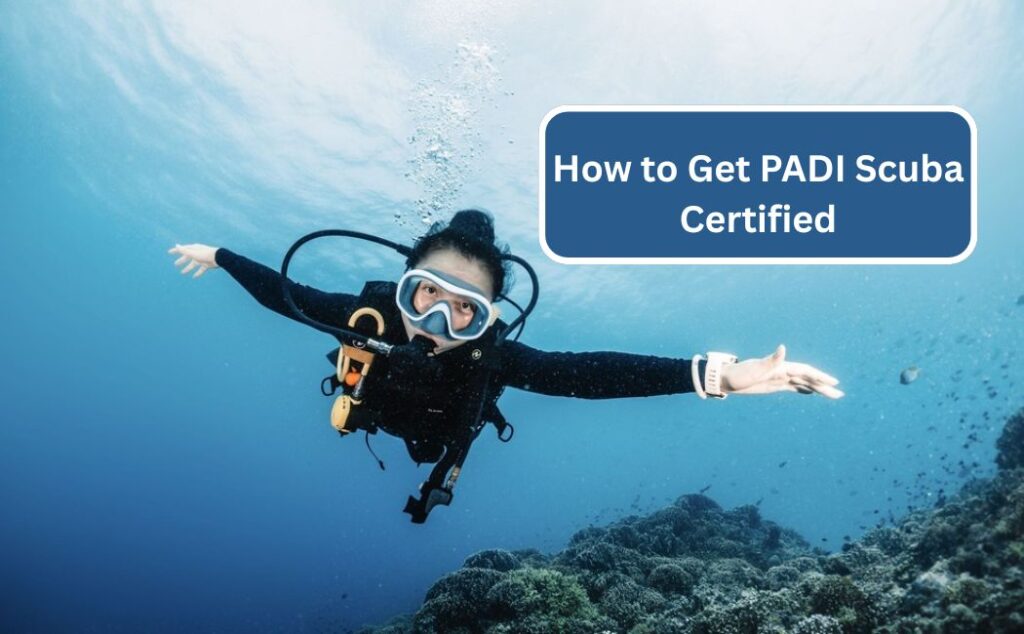
Then I did it. We both did. Over the course of about a month — two full weekends of in-person instruction, including pool sessions and open water dives — we went from complete beginners who had never had a regulator in their mouths to PADI Open Water certified divers. And then, two months later, we used those certifications to do two 60-foot dives off Waikiki in Honolulu. And it was extraordinary in a way that I will never fully be able to put into words.
This is the guide I wish I’d had before I started. Not the official PADI FAQ — you can find that easily enough — but the real one. What the process actually feels like, what to expect at each stage, what made me nervous and how I got through it, and what the moment of actually being underwater for real feels like from the perspective of a moderately anxious adult who had to convince herself the whole thing was a good idea.
Why PADI, and What Does Certified Even Mean?
If you’ve looked into scuba diving at all, you’ve encountered PADI — the Professional Association of Diving Instructors. PADI is the world’s largest scuba diving training organization, with certification programs recognized at dive shops, resorts, and dive sites in virtually every country on earth. When people say they’re “scuba certified,” they almost always mean they hold a PADI certification (or an equivalent from a similar organization like SSI or NAUI, which are all internationally recognized and function the same way in practice).
The PADI Open Water Diver certification is the entry-level credential — the first one, the one that opens the door to everything else. It certifies you to dive to a maximum depth of 60 feet (18 meters) with a buddy, anywhere in the world. It does not expire. There is no annual renewal, no test to retake, and no expiration date stamped on the card. Once you earn it, you are a certified diver for life.
If you are not after certification is an expert. You are a competent beginner — someone who has been trained in the fundamental skills, safety protocols, and emergency procedures needed to dive safely in recreational settings. The course is designed to make you confident and safe, not to make you a technical diver. That comes later, with more experience and more courses, if you choose to pursue it.
What the Certification Course Actually Involves
The PADI Open Water Diver course has three distinct parts, and understanding all three before you start makes the whole process much less intimidating.
Part One: The eLearning Course
The first component is all knowledge — no water involved. PADI now does this entirely online through their eLearning platform, which you access on your computer or phone and work through at your own pace. The course costs around $230 on its own, though most dive shops bundle it into the total course price.
The eLearning covers everything you need to understand before getting in the water: how scuba equipment works, the physics of pressure and depth (the science is genuinely interesting), dive planning basics, hand signals and communication, safety procedures, and what to do in various emergency scenarios. Each chapter includes reading, short videos, and quizzes. At the end, there’s a final exam.
PADI estimates the eLearning takes about eight hours to complete. I spread it over three weeks because I am a procrastinator, but you could realistically do it in two or three dedicated evenings if you’re more disciplined than I am. The material is clear and well-structured — it’s written to be accessible, not technical, and the videos actually help.
My biggest mistake: I did not finish the eLearning before the in-person course began. Do not do this. Our dive shop told us clearly that the eLearning needed to be completed before our first pool session — I had not completed it, I stayed up until 1 AM the night before catching up, and I was exhausted for the first pool day. Do the eLearning in advance. Give yourself real time to absorb it. It genuinely makes the in-water sessions less overwhelming when you’re not also processing new concepts for the first time.
Part Two: The Pool Sessions (Confined Water Training)
This is where the course becomes real. Pool sessions — formally called “confined water dives” — are the in-person portion where you practice every skill you need to demonstrate before you can take your certification dives. You’re in a pool (or pool-like confined water environment) with your instructor, and you work through a structured set of skills over two full days.
At Florida Underwater Sports, the dive shop where we got certified in Sarasota, our class had only three students. Small class sizes matter enormously for this type of instruction — you want individual attention from your instructor, especially for skills that feel uncomfortable the first time you try them.
The pool sessions start with the most basic thing imaginable — putting on your gear, entering the water, and breathing through a regulator for the first time. That first breath underwater is something you don’t forget. Your brain has spent your entire life knowing that water and breathing don’t go together, and then suddenly there you are, breathing air from a tank, sitting on the bottom of a pool. It’s strange and quiet and genuinely magical, even in a swimming pool.
From there, you build. The skills you practice include:
Buoyancy control — learning to add and release air from your BCD (buoyancy control device) to hover in the water rather than sinking to the bottom or floating to the surface. This is the skill that separates clumsy beginner divers from graceful ones, and it takes real practice.
Mask clearing — flooding your mask with water and clearing it out again by exhaling through your nose. This one sounds nightmarish, and it felt nightmarish the first time. By the fourth time, I could do it without flinching. Your instructor will be right beside you, holding your arm if needed. Nobody rushes you.
Regulator recovery — your breathing regulator gets knocked out of your mouth (or you remove it deliberately), and you recover it and clear it. Two methods, both practiced until they’re automatic.
Equalization — clearing the pressure in your ears as you descend. This is the Valsalva maneuver: pinch your nose, blow gently. You need to do this early and often on every descent, before you feel any discomfort. Waiting until your ears hurt means you’ve waited too long.
Controlled Emergency Swimming Ascent (CESA) — this is the one that sounds the most dramatic and turned out to be completely fine. You simulate running out of air and ascending to the surface while exhaling continuously (the expanding air in your lungs as pressure decreases can cause an embolism if you hold your breath while ascending — this is why you never, ever hold your breath while diving). You do it slowly, exhaling the whole way.
Buddy checks — before every single dive, you and your buddy perform a full equipment check on each other. The PADI acronym is BCD, Weights, Releases, Air, Final okay — BWRAF. You will say this in your sleep.
The instructors at our dive shop were patient in a way that I hadn’t fully anticipated. I came in with some anxiety about the mask-fitting skill, specifically, and nobody pushed me or rushed me. You go at your own pace. The course is performance-based, meaning you progress when you’re comfortable and competent, not on a fixed timeline.
Part Three: The Open Water Dives
This is the graduation. Four dives, typically over two days, in a real open water environment — ocean, lake, quarry, or other open body of water. In Sarasota, Florida, Underwater Sports took us to Turtle Beach for shore dives, and the final two dives were boat dives out into the Gulf to local reef and artificial reef sites.
The open water dives are structured: you perform specific skills from your confined water training in the actual open water environment, then explore. They’re not free dives exactly, but they’re also not purely skills practice — you’re actually diving, actually seeing things, actually experiencing what this certification unlocks.
Our shore dives at Turtle Beach were technically a sandy bottom with sea urchins and shells — not the most visually dramatic diving in the world, but an honest and beautiful introduction to being underwater outside a pool. The boat dives into the Gulf where something else entirely. The Silvertooth site — the artificial reef created from the old Ringling Bridge — was covered in life: grouper, stone crab, angel fish, whole sections of structure draped in coral. On my first boat dive, I saw more marine life in thirty minutes than I had in any snorkeling session of my life.
The moment you’re hovering a few feet above a reef, neutrally buoyant, breathing slowly, watching a grouper the size of a golden retriever stare at you from between two old bridge supports — that’s the moment you understand why people become divers. There is no metaphor for it. You’re just suddenly present in a world that exists entirely outside your daily life, in a way that makes everything else seem very far away.
What the Timeline Actually Looks Like
Hannah’s version, which is pretty representative of what many local dive shops offer:
Weeks 1–3: Complete the PADI eLearning at home (don’t wait until the last minute)
Weekend 1 — Two full days in the pool: All confined water training. Long days, but not overwhelming — you’re in the water, learning, practicing, occasionally getting a slight mouthful of pool water while practicing mask clearing. You eat lunch, you laugh a lot, and by the end of day two, you’re surprisingly competent.
Weekend 2 — Two days of open water dives: Shore dives and/or boat dives depending on your dive shop’s program. By this point, you know the skills. The open water sessions feel like putting them to use in the real world.
Total elapsed time: about a month, give or take. Total in-person instruction hours: roughly 16 hours across two weekends. The certification is yours the moment you complete all four open water dives and your instructor signs off.
The Real Cost Breakdown
Scuba certification costs more than the advertised price almost always suggests. Here’s what to actually budget for:
PADI eLearning: ~$230 (sometimes bundled into the course fee — ask)
The in-person course (pool + open water dives): $400–$650, depending on location and dive shop
Equipment rental or purchase: You’ll typically need to supply your own mask, fins, and snorkel (roughly $100–$200 for decent starter gear). The dive shop usually provides the heavy gear — BCD, regulator, wetsuit, tanks, and weights. In Florida’s warm water, a thin wetsuit or no wetsuit is fine.
Total realistic budget: $500–$800 for the full certification, gear rental included
A few things worth spending real money on: a well-fitted mask (this is not the place to use the cheapest option — a poorly fitting mask floods constantly and makes everything harder) and fins that fit your feet properly. The dive shop staff will help you select both.
One thing worth knowing: if you know you’re planning to dive somewhere specific — Hawaii, the Caribbean, wherever your next trip takes you — ask your dive shop about the “referral” option. You complete the eLearning and pool sessions locally, and then finish your four open water dives at your travel destination. This means your certification dives happen in the clear, warm water of wherever you’re going, rather than whatever’s locally available. Some people find this the best of both worlds.
Choosing Where to Get Certified
If you’re in Sarasota, Florida, Underwater Sports on South Tamiami Trail is the answer. They are Sarasota’s only PADI 5 Star Instructor Development Center — the highest designation PADI offers — and a SCUBAPRO Platinum Dealer. The class size was small (three students in our session), the instructors were patient and genuinely enthusiastic about diving and sharing that enthusiasm, and the entire experience from first phone call to open water certification felt like being guided by people who actually cared whether you left as a competent, comfortable diver rather than just a certified one.
Their Silvertooth “Donut Dive” — a regular free community dive at the old Ringling Bridge artificial reef — is one of the best ways to keep diving after you’re certified and build your dive log without any additional cost. It’s social, it’s accessible, and it’s a genuinely beautiful local dive site.
If you’re anywhere else, look for a PADI 5 Star facility in your area — that designation signals a dive center that has met significantly higher standards for instruction, safety, and equipment. Reviews matter too, but the 5 Star rating is the quickest filter for quality.
The Things That Made Me Nervous (And Whether They Were Worth Worrying About)
Mask flooding. Yes, you have to flood your mask and clear it underwater. No, after a few attempts, it is not a big deal. Your instructor stays right beside you. Breathe slowly. Exhale through your nose. The water clears. It’s fine.
Equalizing. My ears were a concern going in because I’ve had sinus issues in the past. The reality: most people equalize without any problem using the standard Valsalva technique (pinch nose, blow gently). The key is starting early — before you feel any pressure — and going slowly. If it’s not clearing, stop descending, try again. Don’t push through pain.
The breathing underwater part. Breathing through a regulator feels slightly odd for the first thirty seconds and then becomes completely natural. Your brain adapts quickly. By the end of the first pool session, the mechanics of breathing underwater felt effortless.
Running out of air. The training covers this extensively — how to monitor your air gauge, when to turn the dive, and what to do if something goes wrong. You dive with a buddy. You never go below a quarter tank without signaling to ascend. The systems built into recreational diving are designed specifically so that “running out of air” is never a surprise.
Sharks. I did not see a shark on any of my certification dives, and this was the question I was asked most by people who knew I was getting certified. Most recreational diving does not involve sharks. If it does, they are typically not interested in you. The actual underwater wildlife that will make you feel things is the grouper, the sea turtle, the ray, the tiny fish that lives in the brain coral — the things you never expected to be moved by.
What Happens After You’re Certified
Your certification card (physical or digital — you choose) is yours. You present it at any dive shop, resort, or live-aboard anywhere in the world to book dives. No expiration, no requalification.
If you haven’t dived for six months or more, most instructors and dive shops recommend a refresher — PADI calls it ReActivate — a short review of skills to make sure you’re current. It’s practical advice, not a requirement, but worth taking seriously.
The certification you’ve earned is a starting point, not a finish line. Once you’re certified, there are advanced courses that expand what you can do:
PADI Advanced Open Water Diver — five more specialty dives (including deep diving to 130 feet and underwater navigation) that dramatically expand your skills and the dive sites available to you
PADI Rescue Diver — widely regarded as one of the most valuable courses a recreational diver can take, focused on identifying and managing diving emergencies
Specialty certifications — wreck diving, night diving, underwater photography, drift diving, and more
We went straight for our Advanced Open Water after returning from Hawaii, and it opened up dive sites that weren’t available to us as basic Open Water Divers. The progression feels natural — each certification builds on the last, and each one makes you a safer, more capable, more confident diver.
The Moment That Made It All Real
The second boat dive of my certification. We were at Turtle Ledge, one of the natural reef sites just off the coast of Sarasota, and I had gotten my buoyancy mostly sorted out by this point — I was hovering, not sinking, not floating, just there. My instructor finned slowly ahead, and I followed.
And then I saw it: a goliath grouper. If you haven’t seen one, goliath grouper are enormous — hundreds of pounds, moving through the water with the unhurried weight of something that doesn’t have predators to worry about. This one was maybe ten feet away. It looked at me. I looked at it. For a long moment, neither of us moved.
That is the moment I became a diver. Not when I passed the final exam, not when my certification card was issued, not when I completed the mask-clearing skill in the pool. It was that grouper at Turtle Ledge, and the stillness of the water around both of us, and the realization that I had access to a world that existed entirely separately from everything I knew.
We put our PADI certifications to use six weeks later in Honolulu. Two dives off Waikiki, 60 feet down, with a company that handled every piece of equipment and showed us sights that I am still processing months later.
All of it began with deciding to do the thing I’d been putting off. With signing up, doing the eLearning, and showing up to the pool on a Saturday morning, slightly nervous and completely willing to learn.
The underwater world is genuinely out there, waiting. The process of getting access to it is manageable, affordable, and transformative in a way that’s hard to explain until you’ve done it.
Go do it.
If you’re in Sarasota and thinking about getting certified, start with a phone call to Florida Underwater Sports — they’ll walk you through the options and help you figure out the right schedule. And if you have questions about what the experience is actually like from the perspective of someone who was moderately terrified and then completely hooked, drop them in the comments. I’m happy to talk about this for a very long time.

Welcome to my blog!
Meet Hannah Katherine, the creative voice behind Lifestyle, a blog dedicated to finding beauty and balance in everyday living. A former interior stylist turned full-time content creator, Sophie blends her love for cozy home design, mindful travel, and self-care into heartfelt stories that inspire readers to slow down and savor the little moments..