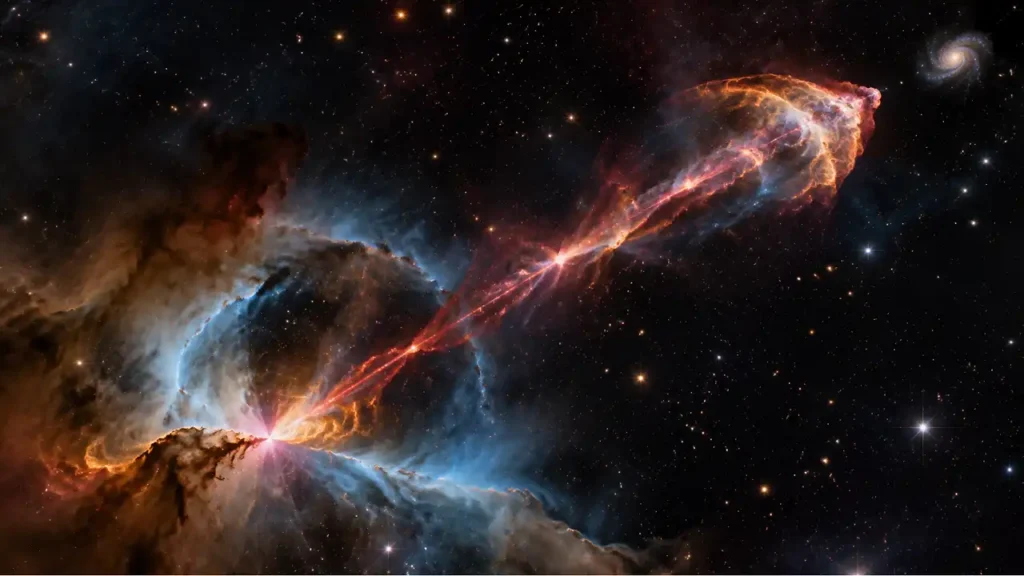
Space telescope imagery is giving the public a closer look at how young stars take shape. New views show a Herbig-Haro and how they are photographed, using the James Webb Space Telescope and the Hubble Space Telescope. The images capture Herbig-Haro 49/50 (HH 49/50) and HH 111 as glowing outflows created by stars that are still forming. Both objects are being imaged at infrared wavelengths, where light passes through the dust that hides them in visible light.
Main Highlights
- Webb’s HH 49/50 image was released on March 24, 2025, using the NIRCam and MIRI instruments across five infrared bands.
- Hubble’s HH 111 image was released on August 30, 2021, using Wide Field Camera 3 (WFC3) in four infrared bands.
- Herbig-Haro objects form when jets from newborn stars slam into nearby gas and dust, creating shock waves that glow.
Profile Overview: Quick Facts
| Detail | HH 49/50 | HH 111 |
|---|---|---|
| Object Type | Herbig-Haro outflow | Herbig-Haro outflow |
| Constellation | Chamaeleon | Orion |
| Telescope | James Webb Space Telescope | Hubble Space Telescope |
| Instruments | NIRCam and MIRI | Wide Field Camera 3 (WFC3) |
| Image ID | weic2506a | potw2135a |
| Release Date | March 24, 2025 | August 30, 2021 |
| Wavelength Range | 2.0 to 7.7 μm | 1.26 to 1.67 μm |
| Field of View | 2.15 x 2.62 arcminutes | 2.28 x 2.03 arcminutes |
| Image Size | 4152 x 5044 px | 1066 x 947 px |
| Credit | NASA, ESA, CSA, STScI | ESA/Hubble & NASA, B. Nisini |
| Legacy | Detailed clues on how sun-like stars form | Proof of infrared’s role in seeing through dust |
Show a Herbig-Haro and How They Are Photographed
What Is a Herbig-Haro Object?
A Herbig-Haro object is a bright region that forms near a protostar, which is a young star still in the process of forming. These stars often launch narrow jets of material into space. When those jets hit surrounding gas and dust, they create glowing shock fronts.
How a Herbig-Haro object forms:
- A protostar gathers mass inside a cloud of gas and dust.
- The young star expels narrow jets of fast-moving material.
- The jets collide with surrounding clouds at hundreds of kilometers per second.
- The impacted gas compresses and heats up.
- The gas cools by giving off light at visible and infrared wavelengths.
ESA describes the arcs in these outflows as similar to the wake behind a speeding boat. Herbig-Haro objects are also relatively rare, because they form only under very specific conditions.
Show a Herbig-Haro and How They Are Photographed
How They Are Photographed: Webb vs. Hubble
The reason new views show a Herbig-Haro and how they are photographed comes down to infrared light. Herbig-Haro objects emit a lot of visible light, but surrounding dust absorbs much of it. Infrared observations are far less affected by dust, so telescopes can record the hidden structure.
| Feature | James Webb Space Telescope | Hubble Space Telescope |
|---|---|---|
| Main Instruments | NIRCam (near-infrared) and MIRI (mid-infrared) | WFC3 (optical and infrared) |
| Light Range Used | Near- and mid-infrared | Optical and near-infrared |
| Key Targets in Light | Molecular hydrogen, carbon monoxide, PAH dust | Ionized iron (Fe II), Paschen Beta |
| Strength | Sees deeper through dust at longer wavelengths | Covers wavelengths close to human vision |
| Example Object | HH 49/50 | HH 111 |
Key terms explained:
- NIRCam: Webb’s Near-Infrared Camera, used here for four of five bands.
- MIRI: Webb’s Mid-Infrared Instrument, used for the 7.7 μm band.
- WFC3: Hubble’s Wide Field Camera 3, which observes optical and infrared light.
- PAH: Polycyclic aromatic hydrocarbons, carbon-based molecules found in dust.
- μm (micron): One-millionth of a meter, used to measure wavelength.
The colors in these images are assigned by scientists. Each filter captures one wavelength, and each is given a visible color so the human eye can read the data. The final picture is a composite, not a single snapshot.
Show a Herbig-Haro and How They Are Photographed in 2026
New Views Show a Herbig-Haro and How They Are Photographed: The HH 49/50 Webb Image
Webb observed HH 49/50 in high-resolution near- and mid-infrared light. The outflow appears in reddish-orange and stretches diagonally across the frame. The full image is available through the ESA Webb image release for Herbig-Haro 49/50.
Webb Filters Used for HH 49/50
| Color Assigned | Wavelength | Instrument | What It Traces |
|---|---|---|---|
| Blue | 2.0 μm | NIRCam | Infrared starlight |
| Cyan | 3.35 μm | NIRCam | PAH dust |
| Green | 4.44 μm | NIRCam | Infrared emission |
| Orange | 4.7 μm | NIRCam | Molecular hydrogen |
| Red | 7.7 μm | MIRI | PAH dust |
Image Highlights
- Outflow arcs: Created by a fast-moving jet striking dust and gas.
- Gas detected: Infrared light highlights molecular hydrogen and carbon monoxide.
- Location: The outflow sits within the Milky Way.
- Background galaxies: Many distant galaxies shine through the diffuse infrared glow.
The Spiral Galaxy at the Tip
A distant spiral galaxy appears at the tip of HH 49/50. This is a chance alignment, not a physical connection. The galaxy shows a blue central bulge of older stars and hints of “side lobes,” suggesting it may be a barred spiral. Reddish clumps in its arms mark warm dust and groups of forming stars.
NASA released a 3D flythrough on April 30, 2025 to show the true distance between the two objects. You can watch the NASA Herbig-Haro 49/50 science visualization to see how far apart they really are.
| Visualization Detail | Information |
|---|---|
| Release Date | April 30, 2025 |
| Format | Video, 1080 x 1920, 30 FPS |
| Data Source | James Webb Space Telescope |
| Purpose | Shows the galaxy alignment is random |
| Credit | NASA, ESA, CSA, STScI |
Adler Gabel Obituary: State College, PA Community Remembers Hockey Teammate
The HH 111 Hubble Image
Hubble captured HH 111 in the constellation Orion using WFC3. The jets in this object are made of ionized gas, which is gas so hot that its atoms have lost their electrons. That charged gas strikes nearby clouds at hundreds of kilometers per second. Full details are listed in the ESA Hubble release for HH 111.
Hubble Filters Used for HH 111
| Filter | Wavelength | What It Traces |
|---|---|---|
| Fe II | 1.26 μm | Ionized iron in shocked gas |
| Paschen Beta continuum | 1.3 μm | Background reference light |
| Fe II | 1.64 μm | Ionized iron in shocked gas |
| Fe II continuum | 1.67 μm | Background reference light |
Why infrared mattered for HH 111:
- Dust blocks much of the visible light from Herbig-Haro objects.
- WFC3’s infrared channel sees through that dust more clearly.
- This capability is described by ESA as crucial to observing these objects successfully.
Related Object: HH 211
Webb has also imaged HH 211, an outflow from a very young star. NASA shared this near-infrared image in September 2023.
| Detail | HH 211 |
|---|---|
| Telescope | James Webb Space Telescope |
| Resolution | Roughly 5 to 10 times higher spatial resolution than earlier images |
| Star’s Mass | About 8% of the present-day Sun |
| Star’s Age Analog | Like the Sun at a few tens of thousands of years old |
| Credit | ESA/Webb, NASA, CSA, Tom Ray (Dublin) |
Jean Shine Obituary: Harker Heights Businesswoman and Military Advocate Dies at 79
Why These Images Matter to Science
These new views show a Herbig-Haro and how they are photographed with tools that reveal what dust once hid. Each image helps scientists study protostar behavior and the early life of sun-like stars.
Scientific value at a glance:
- Star formation: Outflow details show how young stars build mass.
- Jet activity: Images reveal how jets reshape the surrounding cloud.
- Molecular gas: Infrared light maps molecular hydrogen and carbon monoxide.
- Shock physics: Arcs show where jets compress and heat gas.
- Solar history: Young stars offer a glimpse of what our Sun may have looked like early on.
Timeline of Key Herbig-Haro Releases
| Date | Event |
|---|---|
| August 30, 2021 | Hubble releases HH 111 image (potw2135a) |
| September 2023 | NASA shares Webb’s near-infrared image of HH 211 |
| March 24, 2025 | Webb releases HH 49/50 image (weic2506a) |
| April 30, 2025 | NASA releases HH 49/50 3D science visualization |
| July 28, 2026 | NASA updates the HH 49/50 visualization page |
Popular Questions
What does “New Views Show a Herbig-Haro and How They Are Photographed” refer to?
It refers to recent Webb and Hubble images of Herbig-Haro objects. These images show both the outflows and the infrared methods used to capture them.
Why are Herbig-Haro objects photographed in infrared?
Dust around young stars absorbs visible light. Infrared light passes through that dust more easily, which reveals the hidden outflow structure.
Is the galaxy in the HH 49/50 image connected to the outflow?
No. The spiral galaxy is much farther away. Its position at the tip of the outflow is a chance alignment.
Where can you download these images?
ESA Webb and ESA Hubble host the original files. Formats include full-size TIFF, large JPEG, and wallpaper sizes.
Final Word
Together, these releases mark a clear step forward in infrared astronomy. The new views show a Herbig-Haro and how they are photographed using multiple filters, color mapping, and instruments built to see through dust. For readers following space news, HH 49/50 and HH 111 offer a direct look at stars in their earliest stage of life.
RECENT POST
- Show a Herbig-Haro and How They Are Photographed
- Show the Carina Nebula and How It’s Photographed
- Troy Aikman Lawrence McCutcheon Tribute
- Carlsbad Caverns Cheetos Impact