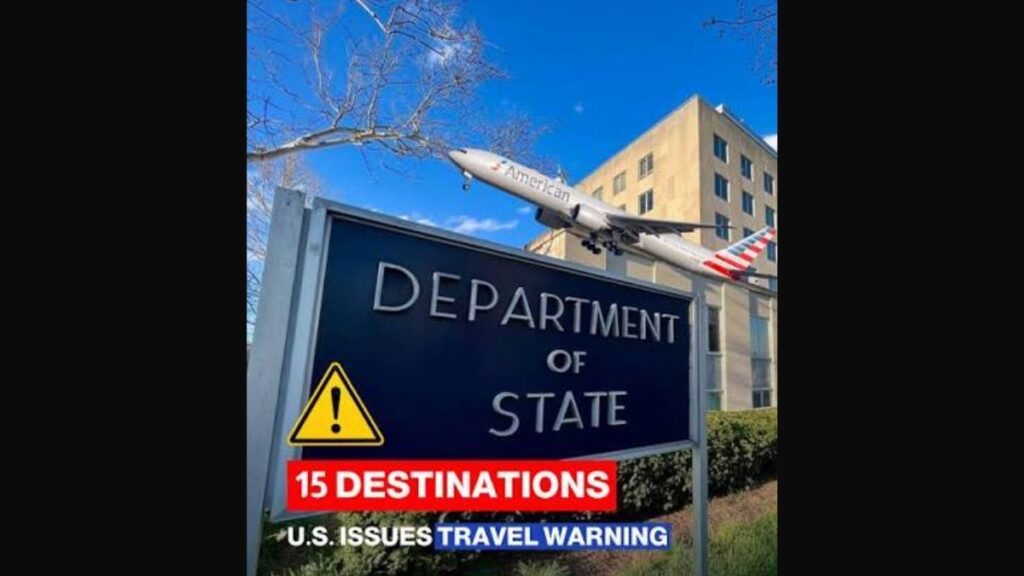
The United States government has told American citizens everywhere, not just in the Middle East, that they could become targets as the war between the United States and Iran grinds on.
The advisory, released on a Saturday in mid-July, marks one of the broadest cautions the State Department has issued in years, reaching far beyond the region where fighting is actually taking place.
A Global Alert, Not a Regional One
What makes this warning stand out is its scope. Past State Department notices during Middle East flare-ups have usually focused on the countries closest to the fighting. This one does not stop at any border. The department explicitly said that groups sympathetic to Iran might go after American interests or people connected to the United States anywhere in the world, not only in countries near the conflict zone.
That single line is what pushed news outlets to describe the alert as a worldwide caution rather than a regional travel notice.
The reasoning behind the broader scope has to do with how the conflict has already spread. Diplomatic posts tied to the United States have reportedly faced threats both inside and outside the Middle East, according to reporting on the advisory. That detail alone explains why officials chose not to limit the warning geographically. If facilities far from the fighting are already being targeted or threatened, then a narrow regional alert would leave gaps.
Americans living or traveling abroad have been urged to register their trips through the State Department’s Smart Traveler Enrollment Program, commonly known as STEP. Doing so allows the nearest embassy or consulate to reach a traveler directly if conditions change quickly, which officials clearly expect could happen.
What Triggered the Latest Escalation
The timing of the warning is tied directly to a deadly attack in Jordan. An Iranian missile and drone strike there killed American service members, with reports placing the death toll from that single incident at two, and additional accounts describing another service member as missing or unaccounted for in the immediate aftermath. Several more troops were hurt badly enough to require medical evacuation, though officials later said those additional injured troops were treated and released from local hospitals.
That attack pushed the overall American military casualty count from the broader conflict higher. Reporting connected to the advisory put the cumulative total at sixteen U.S. service members killed since the war began, with wounded numbers climbing past four hundred. Those figures underscore that this is no longer a limited exchange of strikes but a sustained military campaign that has now stretched close to five months.
President Trump responded to the Jordan attack with a public vow of retaliation, posting online that Iran would pay repeatedly for each American service member it kills.
Hours after the worldwide caution was issued, U.S. forces carried out another round of strikes aimed at Iranian Revolutionary Guard Corps targets, with military officials describing the operation as punishment for the Jordan attack and an effort to further weaken Iran’s military capacity.
Iran’s Supreme Leader, Mojtaba Khamenei, answered with his own defiant message carried by state media, warning that continued American escalation would bring costs and humiliation, and that Iran had what he called unforgettable lessons in store for the United States going forward.
Airports and Embassies Feel the Pressure
Air travel has become one of the most visible casualties of the widening conflict. The State Department cautioned that flight cancellations and periodic closures of airspace could disrupt travel plans across the region, and that warning has already played out in specific incidents.
In Jordan, the U.S. Embassy flagged what it called a specific and credible threat involving Aqaba’s international airport and seaport, advising Americans to steer clear of both facilities. Jordanian authorities pushed back somewhat on the alarm, stating that no evacuation order had been issued and that the airport and port were continuing to operate normally.
Kuwait has been hit directly. Authorities there confirmed intercepting Iranian missiles and drones aimed at the country, and Kuwait International Airport has reportedly been struck by Iranian fire on more than one occasion. Saudi Arabia’s early warning systems have also activated, prompting alerts urging residents in parts of the kingdom to take shelter.
Bahrain saw its own security warning when the U.S. Embassy in Manama told Americans the embassy had reason to believe Iran might target unspecified locations in the capital. That notice included detailed instructions for what to do if an explosion or siren is heard nearby. Americans indoors were told to move to the lowest level of a building, choosing a spot with as few exterior walls and windows as possible, closing doors and staying near an interior wall. Those caught outside were advised to get into a hardened structure immediately, or if none is available, to lie flat and cover their head with their hands.
The Islamic Revolutionary Guard Corps has reportedly attempted strikes against Saudi Arabia, Kuwait, Bahrain, and Jordan, expanding the list of countries directly touched by the fighting well beyond Iran’s own borders.
A Wider Regional Ripple Effect
Perhaps the most consequential development for travelers and global markets alike came from Yemen. The Iran-aligned Houthi movement announced a naval blockade targeting Saudi shipping through the Bab el Mandeb Strait, a chokepoint that plays a major role in global trade and energy shipments. That move has raised fresh concern about maritime security and the broader economic fallout of a war that was originally centered on Iran’s nuclear program and regional influence.
The Strait of Hormuz, another critical passage for oil shipments, has also become a flashpoint, with reports of tanker incidents there adding to the sense that the conflict’s economic reach now extends well past the battlefield itself.
All of this traces back to the collapse of a ceasefire framework that had briefly paused hostilities. That agreement, a memorandum of understanding aimed at halting strikes and opening talks over Iran’s nuclear program and sanctions relief, fell apart after both sides accused each other of violations. Once the truce broke down, strikes resumed quickly, and commercial shipping lanes became targets again alongside military infrastructure.
What Travelers Should Know Going Forward
For everyday American travelers, the practical takeaway is straightforward even if the geopolitical backdrop is not. The State Department is not telling anyone to cancel trips outright, and it has not ordered evacuations from any specific country. What it is doing is asking Americans everywhere, not just those headed to the Middle East, to stay alert, register their travel plans, and watch for updates from local embassies and consulates.
Given how quickly things have shifted over the past several months, from a temporary ceasefire to renewed strikes to a regional naval blockade, officials seem to be preparing the public for continued unpredictability rather than a quick resolution. Airlines are already adjusting routes and schedules around airspace closures, and that pattern is likely to continue as long as active fighting persists.
Anyone with upcoming international travel, especially through hubs in the Middle East or connecting through affected airports, may want to build in extra flexibility for their plans and check State Department updates close to their departure date. Signing up for STEP remains one of the simplest steps travelers can take to make sure they are not caught off guard if conditions on the ground change suddenly.