There is a very specific kind of panic that arrives approximately two weeks before a beach wedding.
You’ve RSVPed. You know what you’re doing that weekend. You have your travel plans sorted, your gift purchased, and your hotel booked. And then someone — a friend, a group chat, a passing thought in the shower — asks: what are you wearing?
And suddenly you remember that beach weddings are the single most confusing dress code in existence. Not black tie. Not casual. Not a cocktail. Something that lives in the exact space between “you’re at a wedding” and “you’re about to walk into the Gulf of Mexico,” and requires you to figure out what that space means for your specific body, the specific couple, the specific ceremony setting, the time of day, and whether it’s going to be eighty-five degrees by noon.
I’ve attended several beach weddings on and near the Gulf Coast, I live fifteen minutes from Siesta Key, I write about coastal style regularly on this blog, and I still find this particular dress code genuinely challenging. What I’ve built, over time, is a framework that works — and this guide is that framework, laid out in full.
The First Thing to Do: Decode the Invitation
Before you look at a single dress, do this: read the invitation carefully. And then look up the venue.
Beach weddings exist on a wide spectrum. A barefoot ceremony at sunset on Siesta Key Beach at 5 PM on a Saturday is a different dress code situation than a catered sit-down reception at a Gulf Coast resort with a waterfront ballroom. Both might be described as “beach wedding” on the invitation. Both call for very different outfits.
Beach weddings can look very different. A sunset resort ceremony may call for a more elevated look, while a daytime barefoot ceremony on the sand may feel more relaxed. Before choosing your outfit, check the invitation, wedding website, and venue.
The specific language to look for:
“Beach casual” or “casual beach attire” — the most relaxed tier. A sundress, a flowy midi, a well-fitting jumpsuit. Daytime, informal, shoes optional (sometimes literally). This is the category where a sundress with espadrilles is exactly right.
“Beach chic” or “beach formal” — the elevated tier. A maxi dress in a beautiful fabric, a structured midi dress, something with intentional details. Heels are possible if the ceremony is on a terrace or lawn rather than sand. Accessories should be considered and deliberate.
“Cocktail” or “semi-formal” at a beach venue — you’re dressing for the formality level, not the sand. An elegant midi or formal maxi. Dressed-up accessories. Heels that work on a hard surface.
When in doubt about the formality level, err slightly more dressed than you think necessary. Overdressing at a beach wedding reads as respectful. Underdressed reads as not having thought about it.
What Not to Try At a Beach Wedding
Some things are universal across every beach wedding dress code, and getting these wrong is the easiest way to make the day harder for yourself or the couple.
Never wear white, ivory, or pale cream. This is not a debate. White, ivory, off-white, blush that reads white in photos — non-negotiable, regardless of dress code. The bride wears white. Period. Even at the most casual barefoot beach wedding, this rule stands.
Never wear stilettos on sand. Stilettos on sand will sink, you will hate the photos, and you will spend the ceremony pretending your shoes are fine. This is purely practical. Save the stilettos for the reception if it’s indoors on a hard surface — and even then, consider whether it’s worth it.
Never wear heavy, non-breathable fabrics. Heavy fabrics that don’t breathe — wool, thick brocade, anything you’d wear to a winter wedding — are wrong for beach weddings. Beach weddings are warmer than the photos suggest. You will be standing in the sun, walking on sand, and likely dancing. Dress accordingly.
Never wear the bridesmaid color if you know it. Most brides won’t say anything, but most also won’t love it. If you’re uncertain, a quick text to confirm is worth the momentary awkwardness.
Never treat it like an actual beach day. The vibe is informal, but remember: you’re still at a wedding, so leave typical beach attire like t-shirts, denim cutoff shorts, and rubber flip flops at home. There’s a meaningful difference between “coastal casual” and “beach casual,” and a wedding always lives on the intentional side of that line.
The Colors: What Works, What Doesn’t, and Why
The beach setting opens up a color palette that formal venues don’t accommodate as well. This is genuinely one of the pleasures of dressing for a coastal wedding.
The colors that work best at beach weddings in 2026:
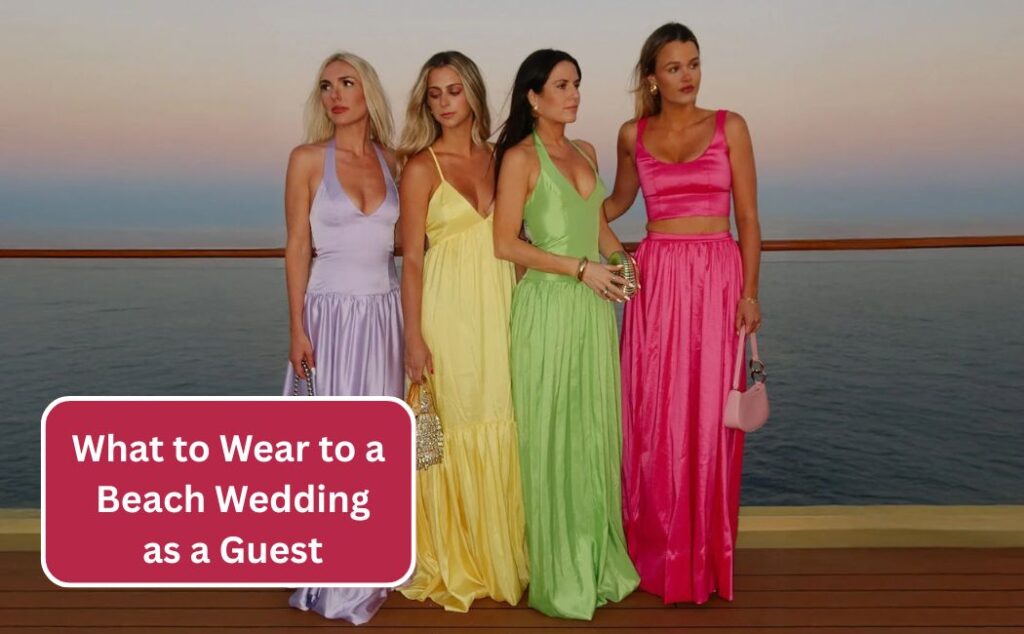
Best colors for beach formal guest dresses include sea blue, sage green, coral, champagne, navy, soft pink, lavender, and warm metallics. These tones work because they read beautifully in natural light, photograph well against sand and water backgrounds, and feel intentional without fighting with the environment.
Coral and warm terracotta are having a significant moment for coastal weddings in 2026 — they’re warm, vibrant, and flattering in golden hour light. Sage green reads elegant and coastal without being predictable. The Navy is classic at nautical venues and works year-round. Warm metallics — champagne gold, soft bronze, light copper — catch the light beautifully at sunset ceremonies.
The colors to approach carefully:
Pale yellow can photograph washed out in strong beach sunlight. Very bright neons feel more party-on-the-beach than wedding-at-the-beach. Black, while always correct in terms of etiquette, can feel heavy in warm-weather coastal settings (though a black midi with statement accessories is perfectly appropriate for a formal beach wedding). Very light blush or pale pink can read too close to white in photographs — choose a deeper, more saturated pink to avoid this.
The print question:
Florals, subtle botanicals, and abstract prints all work beautifully for casual and chic beach weddings. Play around with punchy colors and patterns like nautical stripes, boho prints, or flirty florals. The guideline: bolder prints for daytime casual ceremonies, more subdued prints or solids for evening and formal events.
Febrics
This is the section most beach wedding outfit guides skip — and it’s the one that determines whether you’re comfortable and graceful for the entire event or slowly miserable from 11 AM onward.
Keep fabric choice in mind — a chiffon dress will keep you cooler during the day than something like sequins or taffeta. You can always add a layer, but you can’t take off your dress.
The fabrics that work for beach weddings:
Chiffon — the classic beach wedding fabric for good reason. It’s lightweight, breathable, photographs beautifully in the breeze, and moves with your body in a way that looks intentional rather than chaotic. A chiffon maxi at a beach wedding looks like it was designed specifically for that moment.
Linen — the coastal style essential that I’ve written about extensively in the farmers market outfit guide and the carry-on packing guide. Linen breathes in heat, looks elegant even when slightly rumpled, and has an innately coastal feel that makes it perfect for Gulf Coast and oceanfront events. For a more casual beach wedding, a linen midi or maxi is the most effortless right choice available.
Crepe — a slightly more structured fabric that drapes beautifully and doesn’t wrinkle as readily as linen or chiffon, making it ideal for travel-heavy wedding weekends. It’s slightly heavier than chiffon but still breathable enough for warm-weather events.
Silk or silk-like satin — for more formal beach or resort weddings, a silk midi or maxi has the kind of elevated quality that reads appropriately dressed without being inappropriately heavy. The risk: silk shows sweat and can feel uncomfortable in very high humidity. Best suited to evening ceremonies where temperatures are lower.
Cotton gauze — for the most casual barefoot beach ceremonies, cotton gauze is beautifully relaxed and fully breathable. It has a boho quality that suits informal, intimate beach weddings particularly well.
The fabrics to avoid:
Polyester blends that don’t breathe. Thick satin or taffeta. Velvet, brocade, or anything with significant structure and weight. Sequined fabrics for daytime events (they catch sunlight in unflattering ways and feel heavy in beach heat). Anything that requires professional pressing to look right — beach weekend logistics rarely include an iron.
The Dress Styles: By Formality Level
Casual Beach Wedding (Daytime, Barefoot, Relaxed)
This is the most common Gulf Coast beach wedding format — a late-morning or afternoon ceremony on the sand, often followed by a relaxed outdoor reception. The couple wants their guests to be comfortable, and “casual” on the invitation is genuine permission to dress accordingly.
The flowy sundress. An A-line or wrap sundress in a floral or colorful solid, hitting at the knee or below. Lightweight fabric, comfortable movement, and easily appropriate. Pair with flat sandals or espadrilles, and you’re dressed in under two minutes of decision-making.
The linen midi. A loose-fitting linen dress in a warm neutral or a muted print, hitting at mid-calf. This is my personal default for a casual beach wedding — it’s comfortable in heat, photographs beautifully, and transitions from ceremony to reception without any adjustments.
The maxi dress. For a casual ceremony, a maxi dress in a flowing fabric (chiffon, cotton gauze, or linen) is both elegant and entirely appropriate. Choose a style with some structure at the bodice — a wrap neckline, a smocked top, a subtle ruffle detail — so it reads intentional rather than like a cover-up.
The jumpsuit. A well-fitted wide-leg or palazzo jumpsuit in a breathable fabric is a genuinely chic alternative to dresses for casual beach weddings. Paired with statement sandals and jewelry, it looks considered and distinctive. Practical note: beach bathroom situations in a jumpsuit require a moment of strategy. Plan accordingly.
Beach Chic / Semi-Formal (Elevated Coastal Setting)
The resort ceremony, the sunset cocktail event, the outdoor reception on a terrace overlooking the water — this is the tier that requires the most thought and produces the best opportunities to look genuinely stunning.
The elevated chiffon maxi. A floor-length or near-floor-length dress in chiffon or silk-like fabric with a detail that elevates it past casual — a one-shoulder cut, a ruffle edge, a cowl neckline, an interesting back. This is the standard beach chic silhouette for good reason: it reads elegant in any coastal setting, moves beautifully on camera, and is comfortable enough to wear for a full evening.
The structured midi. A knee-to-calf length dress in crepe, satin, or structured chiffon with a more intentional silhouette — a wrap cut, an asymmetric hem, a clean A-line. This is the option for guests who want something more defined than a flowy maxi and are attending a venue that has an interior reception space.
The embellished option. For sunset and evening ceremonies, adding embellishment — beading at the neckline, delicate lace overlay, metallic thread in the fabric — is entirely appropriate and genuinely beautiful in evening light. Embellishments can go a long way towards dressing up a beach wedding outfit. You can always up the glam factor with statement, sweat-proof accessories like sparkly earrings or strappy embellished heels.
Beach Formal (Resort Black Tie, Waterfront Gala)
The rarest tier, but it happens — particularly at luxury Gulf Coast resort properties and yacht venues.
Beach formal does not usually mean a heavy evening gown. It means elegant, refined, and comfortable in a coastal setting. A floor-length chiffon dress in a jewel tone, a sophisticated silk midi with formal accessories, or a structured maxi in a warm metallic are all appropriate. The guest who shows up in a heavy ball gown at a beach formal wedding is overdressed in the specific way that doesn’t look intentional — leave the heavy structure for an indoor black-tie event.
Shoes
Shoes at a beach wedding deserve their own careful section because the environment creates constraints that normal wedding dress codes don’t.
The best shoe options for beach weddings in 2026:
Wedge espadrilles. The most practical elevated option for a sandy ceremony. The wide, flat base distributes weight across sand without sinking; you get genuine height, and the espadrille aesthetic is inherently coastal. A neutral linen or jute wedge works with virtually any dress.
Block-heel sandals. A chunky heel in a neutral color provides height without the sinking problem of stilettos. A pair of wedding guest shoes with a thicker heel, like raffia block heels, ensures you don’t get stuck in the sand. A neutral color will work well with practically any outfit.
Flat embellished sandals. For casual and chic beach weddings alike, a beautiful flat sandal — strappy leather with metallic detail, embellished toe post, braided leather — is completely appropriate and genuinely elegant when the rest of the outfit is doing its job. Don’t underestimate a good flat.
Strappy metallic heels. For resort and formal beach weddings with hard-surface reception areas — terraces, outdoor pavilions, interior ballrooms — a strappy metallic heel is fully appropriate and very beautiful in evening light. Bring them for the reception; carry flats or wear wedges for any outdoor ceremony portion.
What to avoid: Stilettos (they sink). Rubber flip-flops (not wedding-appropriate). Platforms so high they make sand navigation genuinely dangerous. Closed-toe shoes in very hot weather if the ceremony is in direct sun — your feet will suffer.
The barefoot option: At the most casual barefoot beach ceremonies, no shoes at all is entirely appropriate and actually lovely. If you’re planning to go barefoot, bring a small clutch-sized bag for your shoes rather than carrying them through the ceremony.
The Accessories: Where Coastal Chic Really Lives
The difference between a beach wedding guest who looks thoughtfully put-together and one who looks like they tried very hard is almost always in the accessories. The outfit is the foundation; the accessories are the editorial statement.
Jewelry: Gold is the metal of coastal weddings. Gold, silver, and pearl jewelry are all good options for cocktail beach wedding accessories. For the Gulf Coast specifically — where the aesthetic is warm, organic, and sun-touched — gold particularly works: hoop earrings in a statement size, layered delicate necklaces, a thin gold bracelet or anklet. Pearl accents are having a significant fashion moment in 2026 and are specifically beautiful at coastal weddings — they’re inherently nautical without being kitschy, and they photograph beautifully against sandy backgrounds.
For more formal evening ceremonies, statement earrings in a warm metallic or gemstone tone that pulls from the dress are the most impactful-per-investment accessory choice. Keep the necklace minimal when earrings are doing significant work.
The bag: A cute beaded bag made from wooden beads pairs perfectly with natural surroundings and complements virtually any color beach wedding guest dress. Beyond the beaded bag: a small rattan clutch, a raffia woven pouch, an embroidered evening bag. The guideline for beach weddings is that the bag should feel natural-material adjacent — woven, textured, organic — rather than the polished leather or structured satin clutch you might bring to an indoor formal event.
Size matters for practical reasons: you need your phone, your lip product, your card, and your key. A bag that holds exactly these four things and looks beautiful is the goal. A beach wedding is not the event for a large tote — leave that for the farmers market.
Woven, embroidered clutches are the ideal finishing touch to complete your tropical wedding ensemble — their island vibes add a little touch of fun and whimsy to a seaside celebration.
Hair accessories: This season’s must-have hair accessories come in handy — a headband, bow, or hair clip looks totally on-trend and keeps your tresses in place during ocean breezes. This is genuinely practical as well as stylish — Gulf Coast winds are real, and arriving at a ceremony with your hair styled and leaving with it in your face is an avoidable problem. A pearl-accented clip, a satin bow at the nape, a tortoiseshell claw clip styled deliberately — all of these keep hair in place and add a specific kind of intentional-looking detail that photographs well.
A wrap or shawl: Carry a light shawl or wrap for cooler evening temperatures. Gulf Coast evenings can be perfect at 6 PM and genuinely cool by 9 PM, particularly from October through April. A lightweight silk or linen wrap in a tone that complements the dress serves as a layer for the reception, doubles as an accessory, and takes up almost no space in your clutch until you need it.
Sunglasses: You’ll wear them before the ceremony. Keep them in your bag during. A beautiful frame is worth bringing even if you only wear it for the pre-ceremony hour — they’re part of the coastal aesthetic and the arrival photos.
The Complete Look: Four Occasions, Four Outfits
The Casual Daytime Gulf Coast Ceremony (Barefoot, 11 AM, Sand)
The dress: Linen midi wrap dress in warm terracotta or sage green The shoes: Natural wedge espadrilles or flat embellished sandals; bare feet once on the sand The bag: Small rattan clutch The jewelry: Gold hoops, layered delicate necklaces, a thin anklet The hair: Low bun with a few pieces loose; a tortoiseshell clip for security in the breeze The layer: A thin linen wrap in cream that works as both layer and accessory Don’t: Wear white. Wear stilettos. Wear anything with a lining that feels like a greenhouse.
The Sunset Cocktail Beach Wedding (Resort Terrace, 6 PM, Golden Hour)
The dress: Chiffon maxi in champagne or soft coral; one-shoulder or ruffle detail The shoes: Strappy metallic flat sandal for the ceremony; strappy metallic block heel for the reception The bag: Beaded or embroidered evening clutch The jewelry: Statement pearl or gold drop earrings; minimal necklace; delicate bracelet The hair: Soft waves, half-up style, secured with a pearl pin or satin ribbon The layer: A silk wrap in a complementary tone for after sunset Don’t: Save the best look for an event that’s not this. Sunset weddings deserve the full effort.
The Formal Resort Wedding (Waterfront Ballroom, Black Tie Optional)
The dress: Floor-length chiffon in navy, sage, or deep coral; clean silhouette with elegant detail The shoes: Strappy gold or silver heeled sandal with a block or kitten heel The bag: Small satin or metallic clutch The jewelry: Chandelier earrings or pearl drops; a simple cuff or tennis bracelet The hair: A chignon or elegant updo with minimal accessories The layer: A structured wrap or evening jacket for air-conditioned interior spaces Don’t: Wear a heavy ball gown. This is beach formal, not indoor formal. The distinction matters.
The Boho Beach Ceremony (Outdoor, Bohemian, Casual-Chic)
The dress: Cotton gauze maxi in a botanical or abstract print; smocked bodice, tiered skirt The shoes: Woven flat sandal or embellished leather thong sandal; bare feet for the ceremony The bag: A small embroidered or woven pouch in natural tones The jewelry: Stacked thin gold rings, layered necklaces with shell or stone accents, small gold hoops The hair: Loose waves with a floral hair clip or a thin headband The layer: A crochet or lace kimono over the dress for the ceremony Don’t: Let “boho” become “beach day.” The aesthetic is free-spirited, not casual in the basic sense.
Things to Keep in Mind Before a Beach Wedding
Check the ceremony surface before deciding on shoes. A beach wedding at a resort with a paved or wooden platform ceremony area is fundamentally different from a ceremony directly on sand. If you’re not sure, a quick email to the venue or a look at photos from past events at that space tells you everything you need to know for the shoe decision.
Sunscreen is not optional — but it is a clothing risk. Wear sunscreen (reef-safe — see the Gulf Coast packing list for the full argument for mineral SPF). Apply it before getting dressed. Give it time to absorb before fabric touches it. White cast sunscreen on a silk dress is an avoidable problem.
Dress for the reception weather, not just the ceremony weather. If the ceremony is at sunset and the reception continues into the evening outdoors, the temperature drop from 7 PM to 10 PM can be fifteen degrees. The wrap or layer isn’t optional — it’s the difference between enjoying the reception and spending it cold.
The wind is doing your photography for you. Gulf Coast breezes are what make chiffon and linen look extraordinary at beach weddings — the fabric catches the wind, and the photos look editorial without any effort. Lean into this. Lightweight, flowing fabrics photograph better at beach weddings than structured, stiff ones. Let the environment work with your outfit rather than against it.
Do a full mirror check in motion. Stand. Sit. Bend forward to pick something up. Walk quickly across the room. Raise your arms. Any problem that appears in these movements will appear throughout the wedding day, usually in front of other people. Address it before you leave the house rather than during the ceremony.
Beach Wedding Guest Style at a Glance
| Factor | Casual Beach | Beach Chic | Beach Formal |
|---|---|---|---|
| Best dress length | Knee-midi or maxi | Midi or maxi | Maxi or floor-length |
| Best fabrics | Linen, cotton gauze, cotton | Chiffon, crepe, linen | Silk, chiffon, structured crepe |
| Best colors | Coral, sage, floral prints | Navy, champagne, soft metallics | Jewel tones, warm metallics |
| Best shoes | Flat sandals, espadrilles | Wedge or block heel, flat sandal | Strappy heel, block heel |
| Best bag | Small woven or rattan clutch | Embroidered or beaded clutch | Satin or metallic clutch |
| Best jewelry | Gold hoops, layered chains | Statement earrings, pearls | Chandelier earrings, elegant bracelet |
| Layer needed? | Optional | Recommended | Yes, for evening |
| Never wear | White, stilettos, heavy fabric | White, anything beachy-casual | White, ball gown, heavy structure |
Concluding Lines
Beach weddings are the best kind of wedding to dress for, once you understand the rules. The environment gives you permission to use color, to move freely, to wear your hair a little loose, to choose the beautiful flat sandal over the uncomfortable heel, to embrace fabrics that feel good in the heat rather than fighting them.
Living on Florida’s Gulf Coast, I’ve watched a lot of people get the beach wedding guest look exactly right — and the ones who do are almost always the ones who prioritized comfort and fabric and the actual coastal setting over trying to recreate an indoor wedding look in an outdoor environment.
The beach is not a problem to dress in. It’s the context for an outfit that the beach makes better. Lean into it. Choose the linen. Buy the beautiful flat sandal. Wear the earrings that catch the sunset light.
You’ll look exactly right. And you’ll remember the whole day, rather than spending it thinking about your shoes.

Welcome to my blog!
Meet Hannah Katherine, the creative voice behind Lifestyle, a blog dedicated to finding beauty and balance in everyday living. A former interior stylist turned full-time content creator, Sophie blends her love for cozy home design, mindful travel, and self-care into heartfelt stories that inspire readers to slow down and savor the little moments..