There’s a specific kind of Sunday night feeling that arrives after the wrong kind of travel. You’ve been somewhere — somewhere beautiful, somewhere that people post about, somewhere that required the flight and the hotel and the packed schedule and the group photos and the checking of the boxes — and you’re home, and you’re exhausted, and you’re vaguely certain that you didn’t actually experience the thing you just went to experience.
You saw it. You photographed it. You can confirm that you were there. But somewhere between the airport and the tour bus and the three-museum day and the dinner reservation you were late to because of the museum, the actual place disappeared behind the logistics of visiting it.
I have been on that kind of trip. Multiple times. I have stood in front of things that I genuinely wanted to see and found myself primarily thinking about whether we had time to see the next thing before we needed to get back for the next thing.
And then I moved to Sarasota.
Living on the Gulf Coast — where the beach is fifteen minutes away on a Tuesday, where the farmers market happens every week, and the Sunday drum circle never stops, and the light on the water at 7 AM is different every single morning — has recalibrated something in me about what “experiencing a place” actually means. You don’t experience a place in a highlight reel. You experience it in repetition. In the mundane Tuesday versions of it. In the way the light changes across the same view across different seasons, different moods, different versions of yourself.
That is the insight at the heart of slow travel. And it turns out it applies everywhere — not just to places you live, but to places you visit.
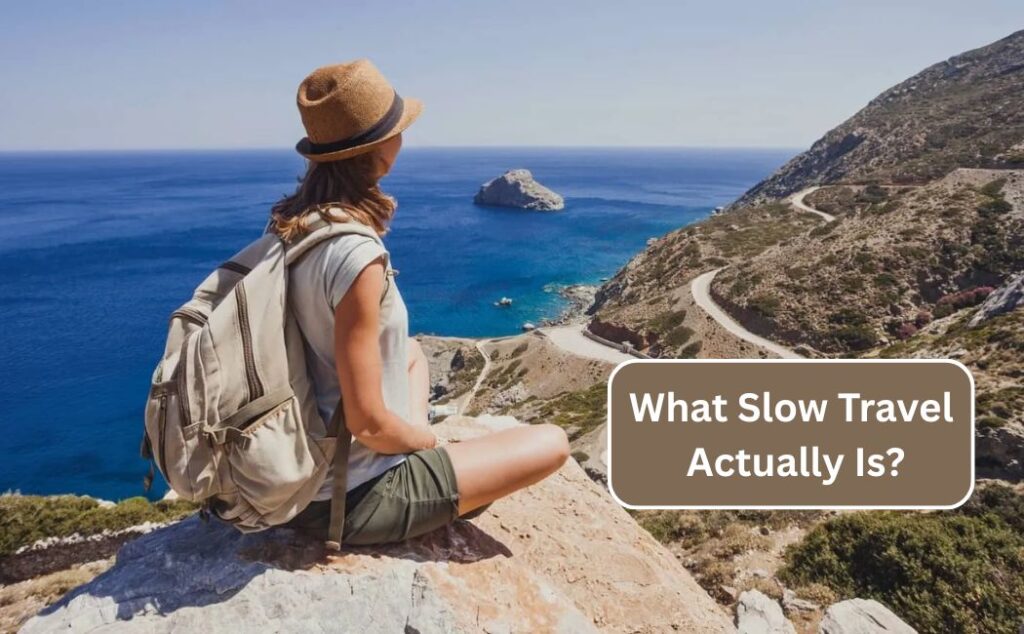
What Slow Travel Actually Is (And What It Isn’t)
Slow travel is a travel philosophy that encourages travelers to spend more time in fewer places, allowing for deeper cultural, environmental, and emotional connections.
Notice what that definition doesn’t say. It doesn’t say cheap. It doesn’t say slow in the sense of torpid or unambitious. It doesn’t say camping instead of hotels or backpacking instead of flying. The relevant distinction isn’t slow versus fast. It’s attentive versus distracted. Intentional versus habitual.
Slow travel emerged as a response to the specific brand of travel that leaves people feeling more exhausted returning home than when they left — the checklist tourism where the destination is a backdrop for the activity of visiting rather than an experience you actually have. As we move through 2026, slow travel has transitioned from a niche lifestyle choice to the dominant travel philosophy.
The historical root is interesting: slow travel grew from the broader Slow movement that began in 1989 when Carlo Petrini founded Slow Food in Italy — a direct protest against the opening of a McDonald’s near the Spanish Steps in Rome. The argument was simple: speed, in the domain of food, was destroying the thing that made food worth having. The same argument applied to travel turned out to be equally true and equally urgent.
Slow travel does not mean doing less. It means experiencing more with intention and awareness. Traditional tourism prioritizes seeing as much as possible in the shortest time. Slow travel takes the opposite approach. The result is a more relaxed, immersive, and memorable travel experience.
The Budget Paradox: Why Slowing Down Makes You Richer
This is the counterintuitive financial case that I want to make carefully, because it’s genuine and important.
Staying longer in one place is often significantly cheaper per day. You can take advantage of weekly or monthly discounts on rentals and avoid the high costs of frequent flights. Younger travelers are increasingly using this “linger-longer” strategy to make luxury feel accessible.
Here’s how the math actually works:
The traditional rushed trip cost structure:
- Flight (round-trip): $400–$800
- Hotel (nightly rate, tourist area): $180–$300/night × 5 nights = $900–$1,500
- Multiple expensive tourist-area restaurants × 5 days = $600–$900
- Attraction fees × 5 days = $200–$400
- Transportation between locations: $200–$400
- 7-day total: roughly $2,300–$4,000+
The slow travel version:
- Flight (same round-trip): $400–$800 (same)
- Apartment rental with kitchen: $80–$150/night × 14 nights (weekly/monthly rate) = $700–$1,400 — often less per night than the hotel
- Groceries + cooking most meals + selective dining out = $400–$600 over 14 days
- Attraction fees spread over more days = $150–$300
- Local transport only (bus, bike, walking): $100–$200
- 14-day total: roughly $1,750–$3,300
You get twice the time for roughly the same or less money. The daily cost of a slow trip — once the fixed cost of the flight is amortized over more days — is consistently lower than the daily cost of a rushed trip.
Beyond the direct costs: the rushed traveler makes more expensive decisions under time pressure. The last-minute tourist-area restaurant because there wasn’t time to research alternatives. The overpriced attraction because you’ve come all this way. The cab instead of the local bus because you’re running late for the next thing. Slow travel removes time pressure, which removes the conditions that produce expensive, impulsive decisions.
The more spacious your schedule, the more you travel like a local. And locals almost never pay tourist prices.
The Mental Health Case: This Is What Travel Is Actually For
Over 60% of travelers prioritize a “mental reset” above all else when choosing travel. Research consistently shows that stepping out of your routine and into a new setting can significantly lower stress, improve mood, and even enhance cognitive flexibility.
But there is a meaningful gap between the kind of travel that produces these benefits and the kind that doesn’t. A five-day European sprint through three countries produces Instagram content and a sense of having done something. It does not produce mental restoration. The cognitive load of constant movement — new airports, new hotels, new cities, new logistics, new orientation — is itself a form of stress, and it competes with the relaxation that travel is supposedly providing.
After years of hyper-productivity and digital saturation, the 2026 traveler is seeking a mental reset. The pandemic accelerated this realization. After months of isolation and travel restrictions, many people emerged with a renewed appreciation for meaningful experiences. The desire to truly connect with a destination — its people, culture, and rhythm — became stronger than ever.
Slow travel offers something that rushed tourism never could: healing, reflection, and intentionality.
The mechanism for this is something I’ve experienced personally — the specific quality of the second week in a place. The first week of any trip is still partially about logistics and orientation. The second week is when the place actually opens up. You know which café serves the coffee you like. You have a regular table at the market. You’ve learned which streets are pleasant to walk and which are loud. You’ve stopped looking at your phone for directions. The place has become, in a small but real way, yours.
That shift — from visitor to temporary resident — is where the mental restoration actually happens. And it requires time that a five-day trip structurally cannot provide.
The Luxury Feeling Without the Luxury Price: The Deep Dive
Let me be specific about what “any budget feels like luxury” actually means, because I don’t want this to read as motivational poster language.
Time is a luxury. The clearest definition of luxury in contemporary life is the freedom to move slowly — to linger over breakfast, to take the longer scenic route, to extend the afternoon because the afternoon is too good to hurry through. This is what money buys for wealthy travelers: not the thread count, but the freedom from schedule. Slow travel grants this freedom through strategy rather than wealth. When you have fourteen days in one place instead of five, you can have a slow breakfast on a Tuesday. You can spend an entire afternoon in one square because you feel like it. You are not measuring every hour against the cost of being somewhere.
The best things are free. This is the observation that repeated travel teaches and that first trips obscure: the most memorable, most genuinely wonderful experiences in any place are almost always free or nearly free. The sunset from a specific hill that a local told you about. The weekly market that doesn’t appear in the guidebook. The conversation with the woman running the corner bakery, who has been there for forty years. The specific light at a specific time of day on a specific street that no photographer has posted because it only happens if you happen to be walking by.
These experiences are inaccessible to the rushed traveler, not because of money but because of time. They require the willingness to wander without an agenda, to be in a place long enough for it to offer itself voluntarily rather than having to extract it on a schedule.
Accommodation improves with length. The apartment with the private garden is rented by the week for $90/night (versus $200+/night at a nearby hotel). The cottage requires a minimum stay of five nights. The guesthouse owner gives you the good room after the first few days because you’ve become a known quantity. The accommodation options that genuinely feel like living somewhere rather than staying somewhere are consistently available to slow travelers and consistently unavailable to people passing through.
Local knowledge is a luxury that takes time to acquire. In my first forty-eight hours in any new place, I eat at the places Google recommends. By day five or six, locals have told me where they actually eat, and the two answers are almost never the same. Local knowledge — the real restaurant, the real coffee shop, the shortcut, the thing happening next Tuesday — is the most valuable information available in any destination, and it is given freely to people who are visibly settled in a place rather than obviously passing through it.
The Environmental Case: Slower Is Cleaner
I want to include this without making it feel like a moral lecture, because I genuinely believe the environmental case for slow travel is compelling on its own terms rather than as an obligation.
Choosing rail over short-haul flights can cut your travel emissions by up to 86–90%. In 2026, rail bookings have surged by 25% as travelers embrace the journey itself as part of the adventure. The single largest contributor to travel’s environmental footprint is flights — and specifically the frequency of flights. The slow traveler who takes one return flight to a destination and stays for three weeks has a dramatically lower travel footprint than the traveler who takes the same flight three times for week-long trips.
Beyond carbon: slow travel naturally reduces the phenomenon of over-tourism that has degraded some of the world’s most beautiful places. When you stay longer in one place and live more like a resident, you distribute your economic impact across local businesses — the neighborhood café, the local market, the independent restaurant — rather than concentrating it in the tourist infrastructure that extracts value from a destination without contributing to it meaningfully.
This is, in the truest sense, travel that gives back to places rather than taking from them.
How to Actually Do This
Theory without practice is just philosophy. Here’s how slow travel works in real life.
Start With the Mindset Shift
The first and most important change is releasing the obligation to see everything. Most first visits to a destination are actually research trips for the second visit. You can spend two days in Paris trying to get to fifteen things and come home with fifteen incomplete impressions. Or you can spend two days in one arrondissement — eating there, walking there, sitting in the cafés there, understanding how it functions — and come home with one deep, fully formed impression that lasts.
This requires accepting that you won’t see the Louvre and the Musée d’Orsay and Versailles and Montmartre and the Eiffel Tower and Notre-Dame on a four-day trip, and being at peace with that. The alternative is seeing all of them and knowing none of them.
Book Accommodation for 5–7 Days Minimum
Book accommodation for 5–7 days. This simple structural change — committing to at least a week in one place — does most of the philosophical work for you. You can’t move through a checklist of sights if you’ve only given yourself one location to be in. The constraint becomes liberation.
Look specifically for accommodation with a kitchen. The ability to buy groceries at the local market and cook your own breakfast is not a budget compromise — it’s a lifestyle feature that produces the specific morning quality that expensive hotels try to manufacture artificially. Your kitchen, your coffee, your pace, your morning.
Choose Fewer Destinations
Instead of cramming five countries into two weeks, focus on one region or city. Explore its hidden corners and let curiosity guide you.
The specific experience that slow travel produces is what curiosity feels like when it’s not racing against a schedule. You notice the side street that looks interesting. You have time to go down it. The thing at the end of it is something you didn’t plan and couldn’t have planned. That is the experience that produces the memory that outlasts the trip.
Opt for Sustainable Transport
Whenever possible, use public transit, rent bicycles, or walk. Not only is this better for the planet, but it also lets you see the world up close.
The local bus is the single most reliable source of unmanufactured local experience available in any destination. The people on the local bus are going somewhere actual — to work, to school, to see someone — and being in that stream of real life for thirty minutes teaches more about a place than a curated tour could.
Walking is the slowest and most information-rich form of transportation. Alain de Botton made the philosophical case: the pace of walking is precisely calibrated to the pace at which meaning can accumulate from visual information. You can’t walk past something interesting at walking pace without noticing it. You can, and do, miss it at any other speed.
Develop Routines
This sounds mundane and is transformative. Find your coffee shop. Go back to it every morning. Find your market vendor. Go back to them every day you shop. These repetitions — this practice of becoming a regular in a place you’re visiting — are what produce the feeling that you know somewhere rather than that you visited it.
The farmers market in Sarasota that I’ve written about throughout this blog — the one on Lemon Avenue that I go to every Saturday — has become one of the fixed points of my week in a way that no tourist attraction could be. I know the vendor who saves me the good sourdough. I know which booth runs out of empanadas first. I know what time the musicians arrive. This level of knowledge, this level of belonging to a place’s weekly rhythm, is only possible through repetition.
When you slow travel, you can build this kind of relationship with a place you’re visiting. Not to the depth that a resident has, but to a depth that a tourist never reaches.
Slow Travel and the Gulf Coast: A Personal Note
I want to be specific about why this philosophy resonates so particularly strongly from where I sit — on Florida’s Gulf Coast, fifteen minutes from one of the world’s finest beaches.
The Sarasota area is — and I say this as someone who has thought about it carefully — one of the finest slow travel destinations in the United States. The beach is free and extraordinary and available every single day. The farmers’ market happens every Saturday without fail. The Sunday drum circle at Siesta Key has been gathering every week since 1996 without anyone organizing it or monetizing it. The Ringling Museum is free on Mondays and never crowded on Tuesday afternoons. The sunset spots are all public and all free. The waterfront restaurants reward regulars.
A week in Sarasota — staying in an Airbnb in Gulf Gate, shopping at Detwiler’s Farm Market, having coffee at Perq or Foxtail every morning, walking the beach before 8 AM, going to the farmers market on Saturday, and the drum circle on Sunday — delivers a quality of experience that a two-night tourist visit simply cannot. The second version costs less per day and produces more of what travel is actually for.
This is slow travel made concrete. And it’s available at every budget level because what makes it extraordinary — the beach, the market, the sunsets, the drum circle, the light on the Gulf at 7 AM — costs nothing.
Frequently Asked Questions
Q: What is slow travel?
A: Slow travel is a philosophy that prioritizes spending more time in fewer places — staying longer, living more like a local, and choosing depth of experience over breadth of destinations. It values presence over productivity and immersion over itinerary.
Q: Is slow travel actually cheaper?
A: Yes — typically significantly cheaper per day. Weekly and monthly accommodation rates are lower than nightly rates. Cooking some meals reduces food costs. Fewer flights reduce the biggest single travel expense. One in four global travelers embraced slow travel in 2025, in part because the “linger-longer” strategy makes travel more financially sustainable.
Q: How long do you need to stay somewhere for slow travel?
A: Minimum 5–7 days in one place. Most slow travelers aim for one to four weeks. The shift from visitor to temporary resident — finding your café, your market, your street — typically requires about five days to begin and rewards longer stays substantially.
Q: What’s the difference between slow travel and regular travel?
A: Regular travel maximizes destinations per day. Slow travel maximizes depth per destination. Regular travel: five countries in ten days. Slow travel: ten days in one city or region, with time to discover it beyond the tourist layer.
Q: Is slow travel better for the environment?
A: Yes, substantially. Fewer flights dramatically reduce the carbon footprint of travel — choosing rail over short-haul flights cuts emissions by up to 86–90%. Slow travel distributes economic impact across local businesses rather than tourist infrastructure, and it reduces the over-tourism that has degraded many popular destinations.
Q: Can you slow travel on a tight budget?
A: Yes — slow travel is often the most effective budget travel strategy. The weekly accommodation discount, the ability to cook your own meals, the local transport rather than tourist transport, and the removal of time pressure that drives expensive decisions all reduce daily cost meaningfully. Slow travel is explicitly how younger travelers make luxury feel accessible.
Q: Where can you slow travel in the United States?
A: Anywhere — but some destinations reward slow travel particularly well. Sarasota’s Gulf Coast has free world-class beaches, a weekly farmers market, daily cultural offerings, and the specific quality of a city that rewards getting to know it. Other excellent U.S. slow travel destinations include New Orleans (neighborhood culture, food, music), Asheville, NC (art, mountains, community), Savannah, GA (historic architecture, food, coastal access), and any national park area where the natural environment rewards unhurried time.