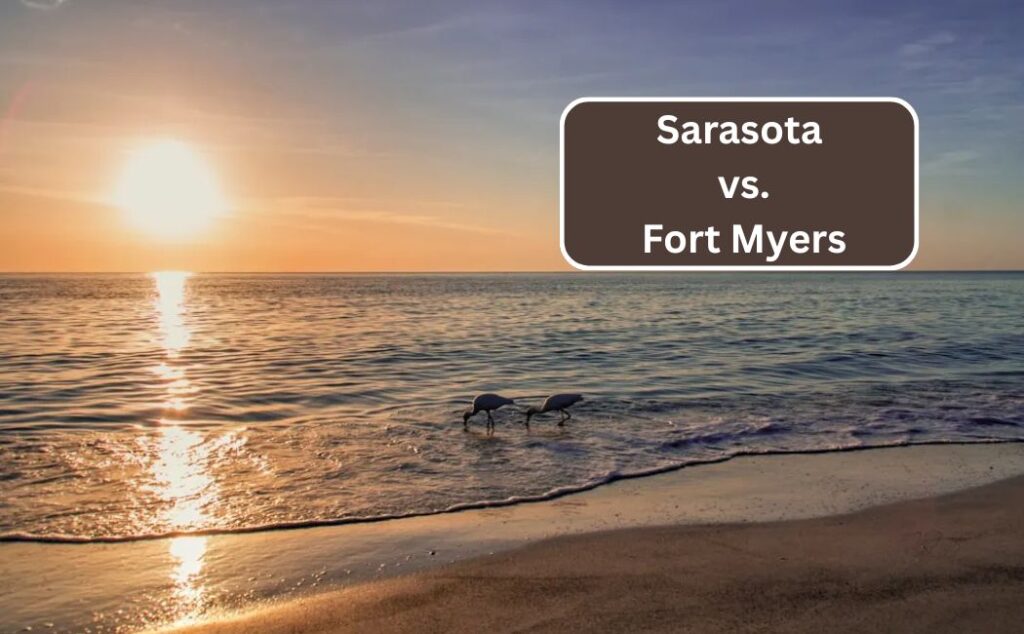
Sarasota is the premium Gulf Coast choice — better beaches, richer arts scene, stronger schools, and a more polished urban feel. Fort Myers is the value play — meaningfully cheaper housing, faster population growth, and a more laid-back coastal rhythm. Fort Myers is 6.3% less expensive than Sarasota overall, with housing costs 21.1% lower. Both cities are genuinely wonderful. The right choice depends entirely on your budget and what you’re actually looking for from Florida life.
I live in Sarasota. I’ve been there since early 2024, and I’ve had enough time to form real opinions rather than impressions. Fort Myers is about 90 minutes south on I-75 — close enough that I’ve been multiple times, far enough that the drive feels intentional rather than casual.
These are two cities that get compared constantly because they occupy a similar position in the Gulf Coast imagination: mid-size Florida coastal cities with good beaches, warm weather, and an appeal that draws both retirees and younger families. But they are genuinely different in ways that matter for the daily texture of life — different in price, different in feel, different in what they’ve built and chosen to be.
Here’s what I know about both, and what the data says about the decision you’re actually facing.
At a Glance: The Numbers That Matter Most
| Factor | Sarasota | Fort Myers |
|---|---|---|
| City population | ~60,000 | ~90,000 |
| Metro population | ~910,000 | ~815,000 |
| Median home sale price (March 2026) | $690,000 | $360,000 |
| Median list price (Realtor.com, 2026) | $595,000 | $334,900 |
| Overall cost of living vs national avg | ~5% above | ~2.4% below Sarasota |
| Housing cost difference | — | 21.1% cheaper than Sarasota |
| Health care costs | — | 20.2% more expensive than Sarasota |
| Employer salary levels | Base | 1.6% lower in Fort Myers |
| Best beach | Siesta Key (#1 U.S., 2026) | Fort Myers Beach / Sanibel |
| School quality | A-rated 22 consecutive years | B to A rated |
| Main airport | SRQ — 65+ nonstop destinations | RSW — 11.1M passengers (2025) |
| Distance from Tampa | ~60 miles (70 min) | ~120 miles (2 hrs) |
| Hurricane Ian impact (2022) | Minor | Severe — Fort Myers Beach devastated |
| Market classification (2026) | Balanced market | Balanced market |
| Best for | Premium coastal lifestyle, arts, beaches | Value, affordability, growth potential |
Cost: This Is Where The Decision Often Gets Made
At a high level, Fort Myers is the value play, and Sarasota is the premium play. Redfin’s March 2026 city data puts the median sale price at $360,000 in Fort Myers and $690,000 in Sarasota.
That $330,000 gap in median home prices is not subtle. It represents the single largest financial difference between these two cities, and it deserves to be understood fully before anything else.
Fort Myers housing costs are 21.1% less expensive than Sarasota housing costs. And Fort Myers is 6.3% less expensive than Sarasota overall.
In practical terms, a buyer with a $500,000 budget in Fort Myers can access neighborhoods with genuine character, good schools, and reasonable proximity to the coast. That same $500,000 budget in Sarasota gets you a significantly more modest property — a condo where Fort Myers would give you a detached home, a starter home where Fort Myers would give you a comfortable one.
Living in Sarasota, FL is 2.4% more expensive than living in Fort Myers, FL. Additionally, employers in Sarasota generally offer 1.6% higher salaries compared to those in Fort Myers.
The salary premium in Sarasota is real but modest — it doesn’t come close to offsetting the housing gap for most buyers. For anyone working remotely and choosing based on lifestyle rather than local employment, the effective financial advantage of Fort Myers over Sarasota is meaningful.
One important counterpoint: health-related expenses are 20.2% more in Fort Myers than in Sarasota. For retirees or anyone with significant healthcare needs, this is a cost that partially offsets Fort Myers’ housing advantage.
The honest cost verdict: Fort Myers wins on housing affordability by a substantial margin. Sarasota’s salary premium and healthcare advantage partially offset this, but for buyers whose primary constraint is price, Fort Myers delivers meaningfully more for your money.
Beaches: A Genuine and Significant Difference
This comparison matters enormously for visitors and residents alike — and it’s not particularly close.
Sarasota’s Beach Advantage
Visit Sarasota says Siesta Key was ranked the best beach in the U.S. for 2026. That kind of beach recognition adds to Sarasota’s profile and helps explain why buyers are often willing to pay more there.
Siesta Key Beach is composed of 99% pure quartz crystal sand that stays cool in summer heat — a geological rarity that produces a beach experience unlike almost anywhere else in the country. The Gulf water is turquoise, warm, and clear. And the access is genuinely excellent: Sarasota’s world-class beaches are much closer to most area neighborhoods and have lots of access points, plus many of them are free to park.
Beyond Siesta Key, Sarasota’s barrier island chain includes Lido Beach, Longboat Key, Crescent Beach, Turtle Beach, and Anna Maria Island — a 35-mile stretch of coastal access that makes beach proximity a realistic daily feature of life rather than a weekend trip.
Fort Myers’ Beach Situation
Fort Myers has genuine beaches — but accessing them requires a different kind of commitment.
Fort Myers Beach on Estero Island is the primary destination — a barrier island beach town with a lively boardwalk and Gulf access. Lovers Key State Park, about eight miles south, is a quieter and wilder alternative. And Fort Myers is 40–60 minutes from Sanibel and Captiva Islands — two of the most beautiful shell beaches in the United States, with Sanibel specifically holding world-class shelling that Venice Beach to the north can’t match.
However, parking is difficult to find near Captiva and Sanibel, and once you do find parking it is pricey — $6+ per hour. The $18 causeway toll to reach Sanibel Island adds further friction to what is otherwise a genuinely spectacular beach destination.
And one unavoidable fact: Hurricane Ian devastated Fort Myers Beach in September 2022. The category 4 storm made landfall near Fort Myers Beach and caused catastrophic damage — flooding, storm surge, and structural destruction that eliminated a significant portion of the island’s commercial infrastructure and housing. Recovery is ongoing in 2026, but Fort Myers Beach is still rebuilding rather than thriving as it was pre-Ian.
The honest beach verdict: Sarasota wins comprehensively — better sand quality (the quartz distinction is real), closer beach proximity to residential areas, free parking at most access points, and no recent hurricane damage to navigate. Fort Myers’ Sanibel and Captiva are genuinely extraordinary for shelling and nature, but the access friction and Ian’s aftermath are real considerations.
Arts, Culture, and What the City Has Built
Sarasota: The Cultural Infrastructure Story
I’ve written about this extensively in other posts on this blog, but it bears repeating because it’s genuinely remarkable: Sarasota has 13 performing arts stages within one mile of its downtown. In a city of 60,000 people.
The Ringling Museum — Florida’s State Art Museum on a 66-acre bayfront estate — would be exceptional in a city five times the size. Marie Selby Botanical Gardens is the world’s first net-positive energy botanical garden complex. Asolo Repertory Theatre is one of the most acclaimed regional theater companies in the Southeast. Florida Studio Theatre operates five stages. The Sarasota Opera has run full seasons since 1960.
Fort Myers, by contrast, tends to appeal to buyers who want a more relaxed coastal rhythm with strong outdoor access. The cultural infrastructure is meaningfully lighter — the Barbara B. Mann Performing Arts Hall hosts traveling Broadway productions and concerts, and the Sidney & Berne Davis Art Center in downtown Fort Myers is a genuine community arts institution. But the depth and density of Sarasota’s cultural offerings don’t have a Fort Myers equivalent.
Fort Myers: Nature and Outdoor Access
Fort Myers counters with something Sarasota’s more developed landscape doesn’t fully replicate: genuine wild Florida at close range.
The J.N. “Ding” Darling National Wildlife Refuge on Sanibel Island is one of the largest undeveloped mangrove ecosystems in the United States — extraordinary bird life, kayaking, and wildlife viewing that rewards regular visits rather than exhausting itself in one trip. Lovers Key State Park, south of Fort Myers Beach, has the specific, undeveloped-island quality that becomes harder to find as development continues northward along the Gulf Coast. The Caloosahatchee River and the broader Estero Bay provide extensive water access for boating, fishing, and kayaking.
For outdoor enthusiasts and nature-first residents, Fort Myers’ proximity to Sanibel’s wildlife refuge and the relative underdevelopment of the Estero Bay coastline is a genuine advantage.
Schools: An Important Gap for Families
This comparison is relatively clear and matters significantly for families with school-age children.
Sarasota County Schools have earned an A-grade from the Florida Department of Education for 22 consecutive years. Pine View School — a public gifted program in Sarasota — is consistently ranked the #1 public school in Florida. The district-wide quality and consistency over more than two decades is a genuine competitive advantage.
Lee County Schools (Fort Myers) have improved in recent years but don’t have the same sustained excellence record as Sarasota. School quality varies more by individual school in Lee County, meaning neighborhood choice matters significantly for families prioritizing education.
The honest school’s verdict: Sarasota is the clearer choice for families who consider school quality a primary factor in relocation decisions.
Hurricane Risk: The Conversation Florida Doesn’t Always Have Honestly
Both cities sit on Florida’s Gulf Coast and fall within hurricane impact zones. But the specific risk profiles are meaningfully different — a fact that affects insurance costs, property decision-making, and the lived reality of coastal Florida life.
Fort Myers experienced Hurricane Ian in September 2022 — one of the strongest and most destructive hurricanes in Florida history. Ian made landfall near Cayo Costa as a Category 4 storm with 150 mph winds, causing catastrophic storm surge and flooding across Fort Myers Beach, Cape Coral, and the surrounding area. Fort Myers Beach was essentially destroyed — the entire commercial and residential infrastructure of the island suffered massive damage, and recovery is measured in years rather than months.
The Lee County coastline’s geography — the broad, shallow Estero Bay and the specific shape of the southwest Florida coast — created conditions that amplified Ian’s storm surge well beyond what wind-speed projections alone suggested. This is a geographic reality that influences insurance costs and risk assessments for Fort Myers coastal properties specifically.
Sarasota experienced Ian as a significantly weaker storm by the time it passed through, producing wind and water damage but nothing approaching Fort Myers Beach’s destruction. Sarasota’s position further north on the Gulf Coast, combined with the protective effect of its barrier islands, has historically offered some geographic mitigation — though it is not immune to hurricane risk, and the moving to Sarasota guide on this blog covers the preparedness reality honestly.
The honest hurricane verdict: Both cities require hurricane preparedness and the associated insurance costs. Fort Myers’ recent Ian experience is a material consideration for coastal property buyers specifically — insurance costs in Lee County reflect the heightened risk profile, and Fort Myers Beach properties specifically carry meaningful additional risk factors.
Airport Access: Closer Than You Might Think
Both cities have regional airports that have expanded meaningfully in recent years.
Fort Myers is served by Southwest Florida International Airport (RSW), located southeast of the city about three miles east of I-75. The airport served more than 11.1 million passengers in 2025. Sarasota-Bradenton International Airport (SRQ) sits about four miles north of downtown Sarasota and serves more than 65 nonstop destinations on 11 airlines.
RSW is the larger airport by passenger volume and has a better route network for direct connections — particularly to the Northeast and Midwest markets that feed Florida’s winter population. SRQ has grown significantly in recent years and now covers the major domestic markets well, with fewer direct international options.
For frequent travelers: RSW’s larger network and more extensive airline competition (including Southwest’s Fort Myers hub) can mean cheaper fares on popular routes meaningfully. SRQ’s smaller scale means shorter security lines, faster ground transportation, and the specific convenience of a fifteen-minute drive from downtown Sarasota.
Tampa International Airport (TPA) — consistently rated among the best airports in the United States for experience and efficiency — is 60–70 minutes from Sarasota and provides access to virtually every major domestic and international market. This is the airport Sarasota residents use for significant travel, and it’s a meaningful advantage that Fort Myers doesn’t have at a comparable driving distance.
Population Growth and Real Estate Trajectory
Fort Myers has experienced faster raw population growth than Sarasota in recent years, driven by its relative affordability attracting migration from more expensive Florida markets and from out of state. Cape Coral — Fort Myers’ sprawling sister city across the Caloosahatchee River — is one of the fastest-growing cities in the United States by population, adding tens of thousands of residents annually.
Realtor.com classifies both Fort Myers and Sarasota as balanced markets in March 2026 — meaning neither strongly favors buyers nor sellers.
The growth dynamic creates interesting investment considerations: Fort Myers’ faster population growth and lower starting price point give it a different appreciation trajectory than Sarasota’s more supply-constrained, premium-positioned market. Whether that represents an investment opportunity or a development-density risk depends on your specific location within the broader Fort Myers market.
Who Lives There: The Community Character
Both cities attract a significant retirement and seasonal population — this is Southwest Florida, and the demographic reality of the Gulf Coast applies to both.
The meaningful distinction is in the diversity beyond that core demographic. Sarasota has developed a more varied permanent community — remote workers, younger families priced into the market by Florida’s relative affordability versus Northern metros, artists and creatives drawn by the cultural infrastructure, and a downtown that actually functions year-round rather than primarily in season.
Fort Myers’ faster growth has brought broader demographic diversity, but the community character varies significantly by specific neighborhood and area. The historic downtown Fort Myers riverfront district has genuine character and an active arts community. The surrounding Cape Coral sprawl — master-planned canals and residential development — has a different, more suburban character. The specific area within Fort Myers matters significantly for understanding what the community feels like day-to-day.
Who Should Choose What
Choose Sarasota if:
- Beach proximity and quality are primary priorities — Siesta Key’s #1 ranking and free access from most neighborhoods is genuinely difficult to match
- Arts, culture, and the specific richness of a small city that takes both seriously matter to your quality of life
- School quality for children is a top-tier factor — Sarasota’s 22-year A-grade record is exceptional
- You can absorb the premium pricing — or you’re coming from a market where Sarasota’s prices feel reasonable by comparison
- Tampa access for air travel, sports, and big-city amenities within 60–70 minutes is meaningful
- You want the urban-coastal balance that Sarasota’s developed-but-not-sprawling character provides
Choose Fort Myers if:
- Budget is the primary constraint, and the 21.1% housing price advantage genuinely changes what you can afford
- Nature and outdoor lifestyle — Sanibel wildlife refuge, Estero Bay, kayaking, world-class shelling — is a central priority
- You’re coming from the Northeast or Midwest, where RSW’s direct flight connections reduce travel friction
- The more laid-back, less curated coastal rhythm of Fort Myers appeals over Sarasota’s more intentional cultural identity
- You’re willing to navigate the Fort Myers Beach post-Ian reality if coastal-island property is the goal
The honest one-sentence summary:
Sarasota is for people who want the best of Gulf Coast Florida and can pay for it. Fort Myers is for people who want Gulf Coast Florida life at a price point that makes the premium lifestyle features of Sarasota inaccessible or unnecessary.
The Full Comparison Table
| Category | Sarasota | Fort Myers | Winner |
|---|---|---|---|
| Housing cost | $690K median (2026) | $360K median (2026) | Fort Myers |
| Overall cost of living | ~5% above national avg | 6.3% below Sarasota | Fort Myers |
| Beach quality | Siesta Key #1 U.S. (2026) | Fort Myers Beach / Sanibel | Sarasota |
| Beach access | Free, close, multiple options | Paid, further, Ian recovery | Sarasota |
| Arts & culture | Exceptional for city size | Good but narrower | Sarasota |
| Schools | A-rated 22 years, Pine View #1 FL | B-to-A, variable by school | Sarasota |
| Nature & wildlife | Good — Myakka, mangroves | Excellent — Sanibel refuge, Estero Bay | Fort Myers |
| Hurricane risk (recent) | Minor Ian impact | Severe Ian impact (2022) | Sarasota |
| Airport access | SRQ + TPA 60 min | RSW — larger network | Tie |
| Job market | Slightly stronger salaries | Growing but lower wages | Sarasota |
| Healthcare cost | Lower | 20.2% higher than Sarasota | Sarasota |
| Growth rate | Steady | Faster (Cape Coral especially) | Fort Myers |
| Best for visitors | Beach, arts, culture | Nature, shelling, value | Depends on purpose |

Welcome to my blog!
Meet Hannah Katherine, the creative voice behind Lifestyle, a blog dedicated to finding beauty and balance in everyday living. A former interior stylist turned full-time content creator, Sophie blends her love for cozy home design, mindful travel, and self-care into heartfelt stories that inspire readers to slow down and savor the little moments..