People ask me this more than almost anything else.
It comes in my DMs, it shows up in comments, friends text it before road trips down to visit us — “Is Siesta Key actually as good as everyone says, or is it just hype?”
And here’s the thing: I live fifteen minutes from Siesta Key. I’ve been there in January when the light is low, and the beach is almost empty. I’ve been there in July at 6:45 AM when the sand is still cool, and the Gulf looks like hammered silver. I’ve watched the drum circle from a beach blanket on Sunday evenings more times than I can count. I’ve walked it with Basil in the dark before the parking lot fills, and I’ve navigated the peak-season crowd at 10 AM on a Saturday in April. I know this beach well enough to have an actual opinion rather than a ranking citation.
So here it is — the honest, personal, local answer to whether Siesta Key Beach is worth visiting. Not the press release version. The real one.
First: Let’s Acknowledge What the World Is Saying in 2026
Before I give you my take, the factual record deserves its moment.
Siesta Beach ranked No. 28 on The World’s 50 Best Beaches list for 2026, climbing from No. 42 the previous year — and it stands as the only beach in Florida, and the only beach in the United States, to make the global top 50. U.S. News & World Report named Siesta Key the No. 1 best beach in the United States in its 2026 Best Vacations rankings. TripAdvisor’s Travelers’ Choice Awards have repeatedly placed it at the top of their U.S. beach lists.
This is not one publication having a moment. This is a sustained, multi-source, internationally recognized acknowledgment that Siesta Key Beach is among the finest beaches on the planet.
So the baseline answer to “is it worth visiting” is yes — it is, objectively, ranked among the world’s best. But you came here for something more specific than that, so let’s go deeper.
Why the Sand Is Different (This Actually Matters)
The most common thing I hear from first-time visitors to Siesta Key is some version of: “I didn’t expect the sand to be like that.”
Siesta Beach’s sand is 99% pure quartz crystal, originating from the Appalachian Mountains — a geological composition that sets it apart from virtually every other beach in Florida. Here’s what that actually means when you’re standing on it:
It stays cool. The quartz composition reflects heat, keeping the sand 10–15°F cooler than beaches like Clearwater or Daytona, even in July. This is not marketing language. In Florida’s summer, this distinction is the difference between a beach walk being comfortable or genuinely painful. On Siesta Key in August, you can walk barefoot at noon. On many other Florida beaches, you cannot.
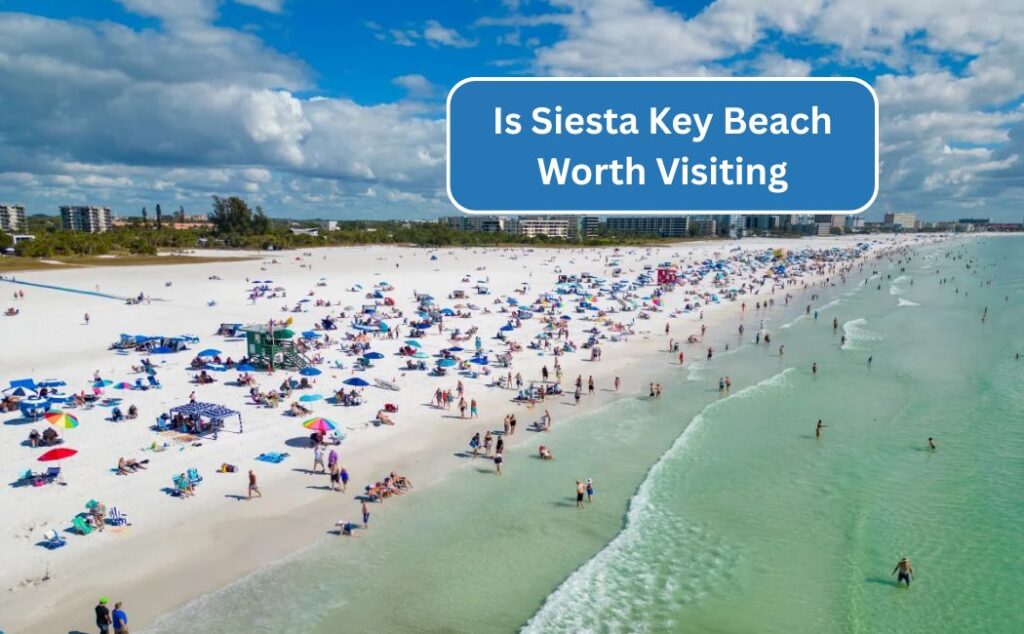
It’s white. Blindingly, surprisingly, stop mid-step white. Not the creamy off-white of most Gulf Coast beaches — genuinely, brilliantly white, in a way that doesn’t look real in photographs and is somehow even better in person.
It’s soft. The beach is over three miles long and wide enough to spread out without feeling crowded, and the texture of the sand is so fine that walking on it feels like something between silk and powder. It squeaks underfoot in a way that sounds like you’re imagining it and isn’t.
I’ve been to beaches all over the country. I’ve stood on the sand at Anna Maria Island (beautiful), Fort De Soto (excellent), Clearwater (very good), and a dozen places in between. None of them feels like Siesta Key. The sand is genuinely, scientifically different, and you notice it immediately.
The Beach Itself: What You’re Actually Getting
Siesta Public Beach functions almost like a sandy civic campus: there are beach access mats, beach wheelchairs available at no cost, concessions, restrooms, a shaded playground, shelters, scenic overlooks, six pickleball courts, four tennis courts, and 10 sand volleyball courts among its amenities. An access mat extends 454 feet toward the Gulf to assist with mobility.
There are over 900 parking spots, and the beach was upgraded in 2025 under a $1.7 million budget that improved playground facilities and the volleyball zones.
What all of this means practically: Siesta Key Beach is one of the most well-equipped public beaches in Florida. It’s not a rough-around-the-edges situation. It’s a genuinely well-run, well-maintained, thoughtfully accessible public space with the world’s best sand. The water entry is gentle — the slope is gradual, and the Gulf bottom is sandy, making it easy and safe for swimming, wading, and floating. The waves are calm by Atlantic standards — this is the Gulf of Mexico, which behaves more like a large warm lake than an ocean in summer.
The Honest Caveats: What Siesta Key Isn’t
You asked for honest, so here’s what Siesta Key Beach is not.
It is not uncrowded. Peak season — November through April — brings real crowds. The main parking lot fills by 9 AM on weekends. The beach itself is large enough that you can always find your own space, but the walk from the parking situation to a good spot requires strategy. Nightly Airbnb rates average $322, and hotel occupancy runs around 82% during the season — meaning the accommodation situation is as competitive as the parking. If you’re visiting in high season without planning ahead, the arrival experience can be frustrating, even when the beach itself is worth it.
The solution, which every local will give you: arrive early. I mean, 7:30 AM is early. The beach before 9 AM in any season is one of the most peaceful things Florida offers — cool sand, flat water, the light doing extraordinary things, almost nobody else there. This is the version of Siesta Key that made me understand why someone would move their entire life here.
It is not a discovery. Siesta Key is famous. Internationally famous, increasingly. If you’re the kind of traveler who wants a secret, you won’t find it here — you’ll find the world’s best sand shared with a lot of other people who also Googled “best beach in Florida.” For the quieter, less-discovered experience, I wrote a full comparison of Siesta Key vs. Anna Maria Island — AMI is the answer if you want extraordinary Gulf beaches without the crowds.
It is not the place for great snorkeling (usually). The Gulf is calm and clear, but it’s not a reef environment at the main beach. The exception is Point of Rocks, at the southern end of Siesta Key — a natural limestone reef just offshore where the water is clear enough to see grouper, angelfish, and tropical species in genuine abundance. Most visitors drive right past Point of Rocks heading to the main beach without knowing it exists. It’s one of the best snorkel spots on Florida’s entire Gulf Coast, and it’s about a ten-minute walk from the main parking area. If you dive or snorkel, make a specific plan to get there. See the PADI certification guide for more on what the Gulf’s underwater world looks like.
Who Should Absolutely Go
Families with children. The gentle slope, the calm water, the sandy bottom, the playground, the concessions, the volleyball courts — Siesta Key is engineered for the family beach experience in a way that more remote or less-developed beaches can’t match. The waters are shallow near the shoreline, making it great for wading and beach walks. Small children can play in the Gulf here with confidence.
First-time Florida visitors. If you’ve never been to the Gulf Coast and you have one beach day to spend, Siesta Key is the correct answer. It is the fullest expression of what makes Florida’s Gulf Coast specifically extraordinary — the warm water, the white sand, the flat horizon, the particular quality of a Gulf Coast sunset. If you have more time, I’d add a day trip to Anna Maria Island and an afternoon at Point of Rocks — but for a single day, Siesta Key is the one.
Anyone who hasn’t stood on this sand before. I’m being slightly grandiose here, but I mean it: the experience of walking on Siesta Key’s sand for the first time is worth the trip from wherever you are. It’s one of those sensory moments that stays with you. The coolness underfoot in summer. The whiteness. The texture. It genuinely doesn’t feel real, and then it does, and then you understand why it keeps ranking first.
People who want a complete beach infrastructure. Free parking, restrooms, concessions, volleyball, pickleball, tennis, playground, beach wheelchair access — Siesta Key has it all. If you’re the kind of traveler who wants amenities alongside the beauty, this is your beach.
Who Might Prefer Something Different
The crowd-averse traveler. If your ideal beach day involves genuine solitude and the feeling of having found something, Siesta Key in peak season is not it. Go to Anna Maria Island’s Bean Point instead — it requires a walk to reach, rewards it enormously, and offers a quality of quiet that Siesta’s main beach can’t match in high season.
The budget traveler with limited mobility. The parking situation at Siesta Key requires either very early arrival or the willingness to park further away and use the free Siesta Key Breeze Trolley. It’s entirely manageable, but it requires planning.
The traveler looking for Florida’s quirky, local, historic side. Siesta Key is beautiful, but it’s been discovered. For Old Florida before it’s gone, I’d point you toward Cortez Village, thirty minutes north — a working fishing village that has somehow survived everything, where the mullet is smoked fresh, and the pelicans don’t move for anyone.
The Things That Make Siesta Key More Than a Beach
Here’s what the rankings don’t fully capture: Siesta Key has a personality, and it’s a good one.
Siesta Key Village. A few blocks from the main beach, the Village is a walkable cluster of casual restaurants, bars, shops, ice cream, and live music that gives the island an afterlife beyond the beach itself. After a morning in the water, you walk to the Village barefoot (it’s that kind of place), get fish tacos and a frozen drink at the Daiquiri Deck, and decide whether the afternoon is for shopping or a second round of swimming. The Village is what separates Siesta Key from beaches that are beautiful but have nowhere to go when you’re done.
The Sunday Drum Circle. The Siesta Key Drum Circle gathers every Sunday evening on Siesta Beach starting about an hour before sunset. It began in 1996 when David Gittens gathered about a dozen friends to play drums for the vernal equinox, and has since grown into a weekly gathering of musicians, dancers, families, visitors, and sunset-watchers. Thirty years later, it’s still there. Still free. Still one of the most genuinely joyful, community-driven things I’ve encountered anywhere in Florida.
I’ve written about the drum circle elsewhere on this blog, but what I want to say here is this: if you visit Siesta Key on a Sunday and leave before sunset, you’ve left the best part behind. Plan the week around it. Arrive an hour early. Bring a blanket. Watch the sky turn and the drums build and the circle form and understand that this beach has something beyond a ranking — it has a community that genuinely loves it.
The proximity to Sarasota’s cultural infrastructure. This is the advantage that puts Siesta Key in a category of its own compared to more remote barrier islands. Within ten to twenty minutes of the beach, you have the Ringling Museum, Marie Selby Botanical Gardens, downtown Sarasota’s farmers market, and the waterfront restaurant scene detailed in the guide on this blog. A Siesta Key beach day is the beginning of a full Sarasota experience, not a standalone destination.
How to Do Siesta Key Right
When to arrive. Before 9 AM, any day. Before 8 AM on weekend mornings during the season. The beach before the crowd arrives is a different experience entirely — calmer, cooler, more beautiful, more yours.
Where to park. The main Siesta Key Beach parking lot on Beach Road is free with over 900 spots. The free Siesta Key trolley service transports visitors around the island if you’re staying in the Village or parking off-site. Street parking on residential roads near the Village is also an option for early arrivals.
What to bring. Reef-safe mineral sunscreen (the full reasoning is in the Gulf Coast packing list), Turkish towels (sand-resistant and quick-dry), plenty of water (more than you think), and a hat with a real brim.
What to eat. Beach snacks from Detwiler’s Farm Market the evening before, coffee from somewhere in the Village, fish tacos for lunch at the Daiquiri Deck or the Siesta Key Oyster Bar (SKOB). Stay for the Village energy in the afternoon — it earns the extra hour.
Best season. Late September through mid-November offers the best combination of value and experience — daytime highs around 83°F, warm Gulf water, and crowds 40% lighter than spring break. Summer is hot, but the water is extraordinary and the parking is more manageable. Winter is beautiful, and full — peak season brings the best weather and the most competition for space.
The Final Answer
Yes. Siesta Key Beach is worth visiting.
It is worth visiting for the sand alone — a geological distinction that produces a sensory experience you won’t find at any other beach in the United States. It is worth visiting for the warm, clear, gentle Gulf water that summer brings. It is worth visiting for the drum circle on a Sunday evening, for the walk to Point of Rocks, for a fish taco in the Village after a morning in the water, for a sunset that the whole beach stops to watch together.
It is not worth visiting if you expect to have it to yourself in peak season, or if you arrive at 10 AM on a Saturday in February and expect parking to be simple, or if what you’re looking for is a secret that hasn’t been discovered. It is the world’s best-ranked public beach, and enough people know it now that the experience requires timing and strategy rather than spontaneous arrival.
But here’s what I’d say to anyone who asks me in the comments or the DMs or over dinner when they’re visiting: plan your arrival right, bring good sunscreen, and go early enough to have it to yourself for an hour before the world catches up.
That hour is one of the best things Florida offers. I’ve been experiencing it for over a year now, and I still stop mid-walk sometimes and think: I can’t believe we get to live here.
That feeling is worth everything.
Siesta Key Beach at a Glance
| Factor | Details |
|---|---|
| 2026 ranking | #1 Beach in the U.S. (U.S. News & World Report), #28 World’s 50 Best Beaches |
| Sand composition | 99% pure quartz crystal — stays 10–15°F cooler than typical Florida beach sand |
| Beach length | Over 3 miles end to end |
| Parking | Free, 900+ spots — arrive before 9 AM on weekends |
| Trolley | Free Siesta Key Breeze Trolley runs seasonally |
| Amenities | Restrooms, concessions, playground, volleyball (10 courts), tennis (4), pickleball (6), beach wheelchair access |
| Best time to visit | Sunrise–9 AM any day; late September–November for value + fewer crowds |
| Water temperature | 85°F+ in summer; warm year-round |
| Dogs allowed? | No — see the dog-friendly beaches guide for alternatives |
| The drum circle | Every Sunday, ~1 hour before sunset, between lifeguard stands 3 and 4 |
| Nearest restaurants | Siesta Key Village, 5-min walk from main beach |
| Access to Sarasota | 15 minutes to downtown; Ringling Museum, farmers market, fine dining all nearby |
Have questions about visiting Siesta Key that this post didn’t answer? Drop them in the comments — I check them all. And if you’re building a full Sarasota itinerary around your beach trip, the complete first-timer’s weekend guide has everything you need to make the most of this city.

Welcome to my blog!
Meet Hannah Katherine, the creative voice behind Lifestyle, a blog dedicated to finding beauty and balance in everyday living. A former interior stylist turned full-time content creator, Sophie blends her love for cozy home design, mindful travel, and self-care into heartfelt stories that inspire readers to slow down and savor the little moments..